
You’ve got a camera, you’re making videos for your audience, and somewhere in the back of your mind you know podcasting could work for you. But then you think about recording separate episodes, editing them to perfection, getting a fancy mic, sorting out distribution channels. So you don’t start. And that’s the trap, because if you’re already creating video content, you already have everything you need to turn your videos into podcast episodes. You’re just not exporting it differently yet.
Here’s the thing: the bar for podcasting is way lower than people have convinced themselves it is. Most creators skip audio entirely because they’re imagining a production process that doesn’t need to exist. You don’t need new content. You don’t need extra hours. You need a system that takes what you’ve already made and moves it to another platform with zero ego about polish.
This post breaks down exactly how to reuse video as podcast episodes without the friction, the perfectionism, or the extra work. By the end, you’ll know why consistency beats production quality every single time, and how to set up a repeatable process that actually sticks.
TL;DR for the Impatient Nugget Seekers
- 47% of people quit podcasting before episode 3. It’s not because they lack talent. It’s because they made the system too complicated. Extract audio, add beats, upload. Done.
- If you’re making videos, you’ve already got a podcast you’ve never exported. Stop waiting for permission to release it. The audience doesn’t need perfect. They need you to show up.
- One video becomes a podcast episode, clips, emails, and community posts. Burnout comes from not having a system, not from lack of ideas. Multiple formats from a single piece of content is how you actually scale without breaking.
- The moment you decide your podcast needs to sound professional, you’ve lost. Raw, consistent audio from someone real beats polished silence every time. Your listeners are driving, walking, doing dishes. They’re there for your thinking, not your production budget.
- Most creators think each platform needs completely different content. It doesn’t. One strategic piece of content hits 5-6 different audiences when you stop treating repurposing like a chore and treat it like a system.
Right, let’s get into it.
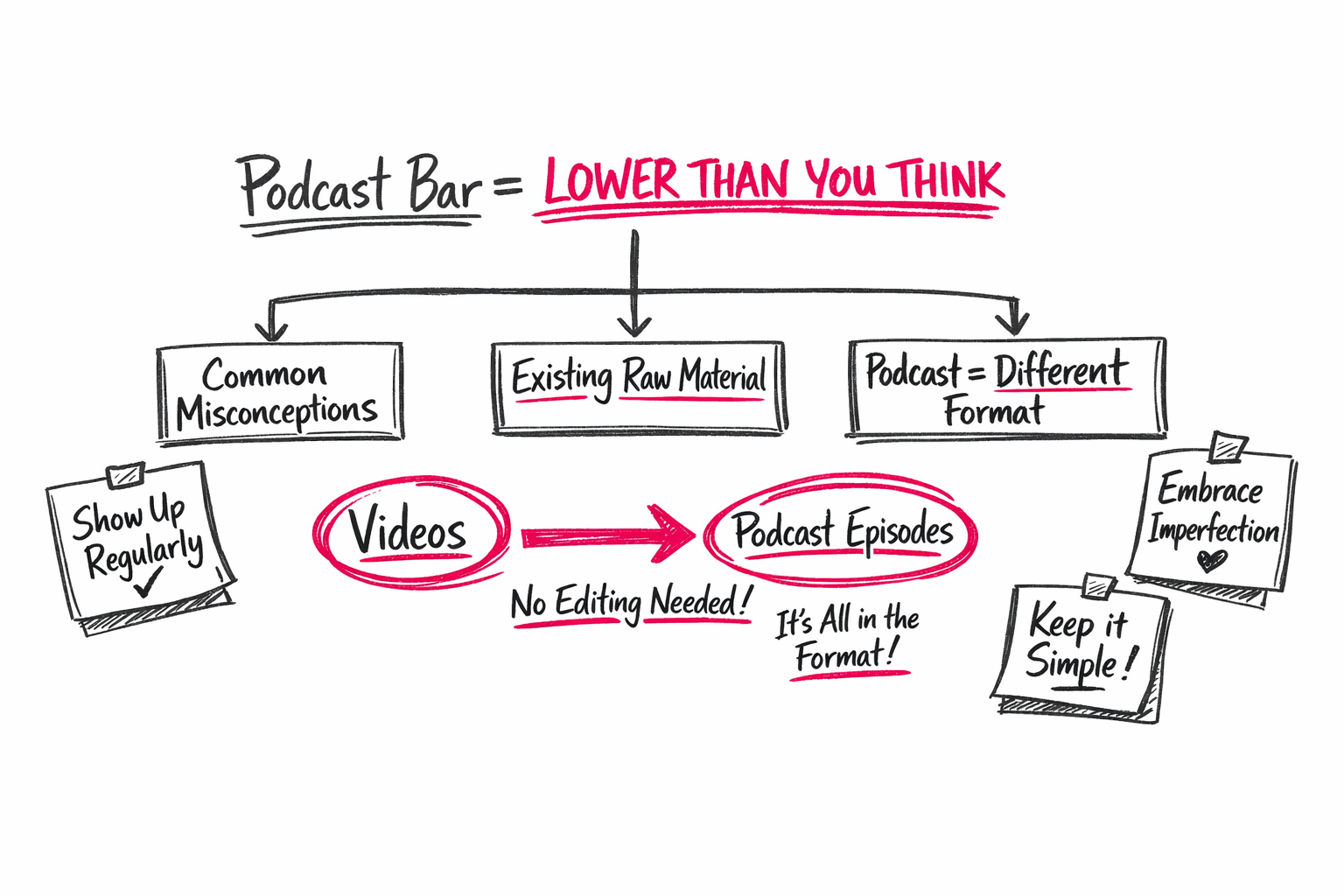
The podcast bar is lower than you think (and that is good news)
You probably think podcasting is hard. That you need expensive equipment, pristine audio, a separate recording schedule, someone to edit it all. That it’s this whole other skill you have to master and maintain alongside everything else you’re already doing. I get it. That’s what most people think, and it’s exactly why 47% of podcasts stop before episode three and only around 15% of shows on major platforms are even active.
But here’s the thing: that’s not a sign that podcasting is difficult. It’s a sign that people believe it is. And there’s a massive difference.
The real problem isn’t that the bar is high. It’s that we’ve all collectively agreed the bar is higher than it actually is. We’ve internalised some imaginary standard about what a “proper” podcast should sound like, and then we quit before we even start because we’re convinced we can’t hit it. The opportunity that sits in that gap is enormous.
Why you’re probably overcomplicating it
Most business owners already create video content. You’re on calls with clients. You’re recording reels or TikToks or YouTube shorts. You’re filming yourself explaining your process, your thinking, your take on something. That’s a podcast. You literally already have the raw material.
The only difference between that video and a podcast episode is the format. It’s not a second job. It’s not even a new skill. It’s an export and an upload. That’s it. You don’t need to re-record anything. You don’t need to learn new software. You don’t need someone to spend hours editing it into some polished thing that sounds like a professional studio production.
I covered this whole approach on this week’s episode of The Marketing Strategy Show, including why most podcasts fail and exactly how I set up the system. Here it is if you want the full walkthrough.
I’ve been running The Rebellious Business Show for over a year now. We don’t edit the episodes. They go up raw. And we’re in the top 30% of shows on Spotify with a 383% increase in new audience. I’m not telling you that to brag. I’m telling you that because the standard you think you need to hit does not exist.
Turn your videos into podcast episodes without believing the myth
When you turn your videos into podcast episodes, you’re not creating new content. You’re multiplying what you’ve already made. One piece of video becomes audio for another touchpoint. Same substance, different format, zero extra work beyond an SOP and a consistent prompt.
What stops most creators isn’t the technical side. It’s the belief that imperfection means failure. But imperfect and human will always beat polished and generic. Gary Vaynerchuk publishes podcast episodes that sound echoey. He gets millions of downloads. It’s not about having perfect content. It’s about showing up regularly and giving people another way to connect with you.
A podcast is just a touchpoint. It’s how your audience builds familiarity and trust with you whilst they’re driving or walking or doing the washing up. That locked in attention is gold. But if you make it hard for yourself to keep doing it, you won’t. Systems beat perfection every single time. So don’t overcomplicate it. Extract the audio, add it to your distribution, move on.
You already have a podcast if you are already making videos
Here’s what I want you to understand: if you’re creating video content right now, you already have a podcast. You’ve just never exported it that way. A podcast episode is nothing more than audio extracted from something you’ve already filmed, bundled into a file, and uploaded to a distribution platform. That’s the entire mechanic. There’s no second recording session. There’s no separate skill. There’s no new workflow to master.
Most business owners I talk to have this romanticised idea of what it takes to run a podcast. They imagine sitting down in a quiet room with a microphone, hitting record, speaking into the void for thirty minutes, then handing it off to an editor. That’s not what this is. If you’re already on Zoom calls with clients, filming reels, recording yourself explaining something on camera, or going live on Instagram or TikTok, you’ve already got the raw material. You just need to treat it as latent podcast content instead of content that ends at the video upload.
What you actually need to turn your videos into podcast episodes
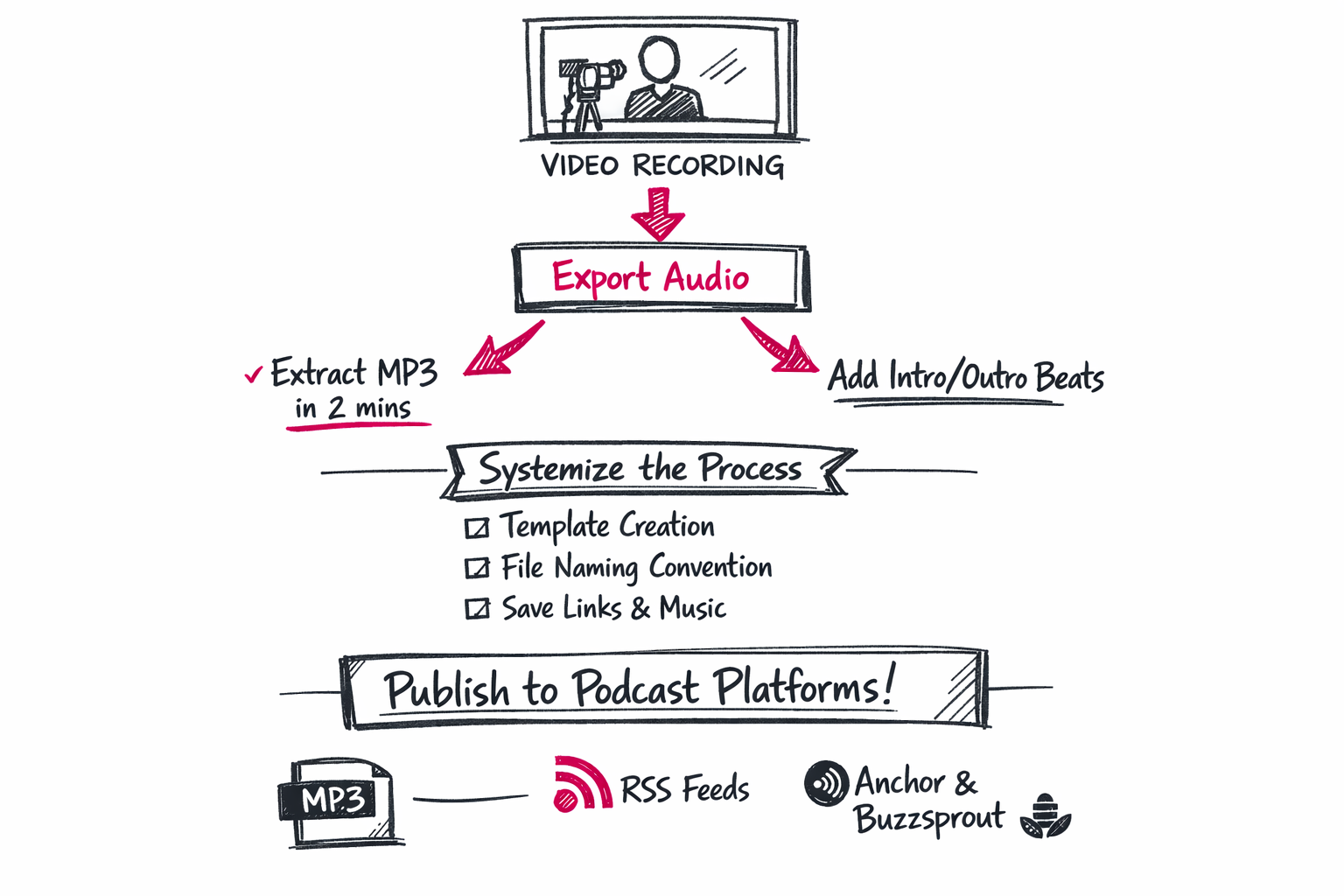
The process is mechanical. Extract the audio file. Ensure you’ve got a clean intro and outro (a five-second beat at the start and end is enough). Upload the file to your podcast host. Done. If you’re already making videos, this is not creating new content. It’s multiplying what you’ve already made by exporting it in a different format.
I know what people worry about at this point. The audio quality. Whether the sound of the room will come through. Whether it’ll sound “too raw.” And I’m going to be direct: it doesn’t matter as much as you think. People listen to podcasts while they’re doing other things. They’re driving. They’re cooking. They’re walking. They’re not sitting at a desk with professional speakers waiting to critique your room noise. They’re there for your thinking, your voice, your perspective. That’s what they’re paying attention to.
If you want to genuinely reduce friction in this workflow, tools like Descript make it worth considering. You can edit video like it’s a text document, and the transcription happens automatically. If you’ve filmed something that needs a section trimmed out or a pause removed, you can literally delete the words and the audio adjusts around them. For someone managing multiple content streams, that genuinely simplifies the conversion step. But even that isn’t essential. You can do this with basic software.
The actual system for turning recorded video into podcast
Here’s how I’d structure it. You film or record something on video as you normally would. Once it’s done, you extract the audio (most video editing tools do this in two clicks). You add a thirty-second intro beat and outro beat to the front and back. You write a short description of what the episode is about. You upload the file to your podcast host and hit publish. That’s the system.
The reason most people don’t keep a podcast going isn’t because podcasting is hard. It’s because they’ve made the system too complicated. They’ve layered on expectations about what it should sound like, who should edit it, how many hours of post-production work it should involve. Then they can’t sustain it, so they quit. Systems beat perfection every single time. You don’t need perfect audio. You need a process you can repeat without thinking about it.
Why repeating one video across multiple formats is the system that scales
Here’s the thing most content creators get wrong: they think each platform needs a totally different piece of content. So they make a YouTube video, then they panic about what to post on Instagram, then they write a LinkedIn thing, then they feel obligated to start a newsletter. Everything feels new. Everything feels hard. Everything burns them out.
But you don’t need new content. You need leverage.
One piece of content, a single video you’ve already recorded, can become your podcast episode, a handful of short clips, email sequences, community posts, and probably a few things you haven’t thought of yet. When you turn your videos into podcast episodes without extra work, you’re not being lazy. You’re actually being strategic. You’re hitting different audience segments where they already spend time. You’re building familiarity and trust across multiple touchpoints instead of exhausting yourself chasing the algorithm on one platform.
The reason most business owners quit content isn’t because they lack talent. It’s because the system is unsustainable. When you have to create six different pieces of content from scratch each week, you’ll burn out by month two. When you’re repurposing one video into six formats? That’s actually doable long-term.
The multiple touchpoint reality
I used to think social media was enough. Then I looked at actual reach numbers, and they’re brutal: 2 to 5 per cent of your followers even see your posts, let alone engage. Email sits at about 25 per cent open rates. Podcasts have different listeners entirely. The chance that your ideal client sees you on Instagram is already low. The chance they see you in multiple places? That’s exponentially higher.
This isn’t about being everywhere. It’s about being reachable to the people who actually need what you do. They might find you through a podcast episode while they’re commuting, then see a clip on social media, then join your email list. Each format is another way the same message reaches different brains at different moments.
When you extract audio from a video and publish it as a podcast episode, you’re not duplicating effort. You’re multiplying reach. You’re meeting your audience where they already are. Some people don’t watch YouTube but listen to podcasts religiously. Some scroll social media but never open email. The repurposing strategy acknowledges this reality instead of fighting it.
Why the friction kills the system
Here’s what I’ve noticed: if repurposing is hard, you won’t do it consistently. You’ll do it once, think “that was annoying,” and then stop. The whole strategy collapses. The only way this works is if the workflow is so smooth that it becomes automatic.
That’s why tools matter, but not in the way people think. You don’t need a tool to create content better. You need a tool that removes friction from the repurposing itself. Something that automatically clips your long-form video, syncs captions, and prepares shorts without you manually scrubbing through footage. When the mechanical part is handled, you can actually focus on the strategy: where does each piece of content go, and what does your audience need to hear right now?
If you’re manually editing video clips and uploading them to five different platforms, you’ve already lost. The system’s too complicated. You’ll quit. I’d quit too.
One piece of content becomes many because you’ve built a system that doesn’t rely on willpower. It relies on process. That’s the only way consistency actually happens.
Imperfect and human will always beat polished and generic
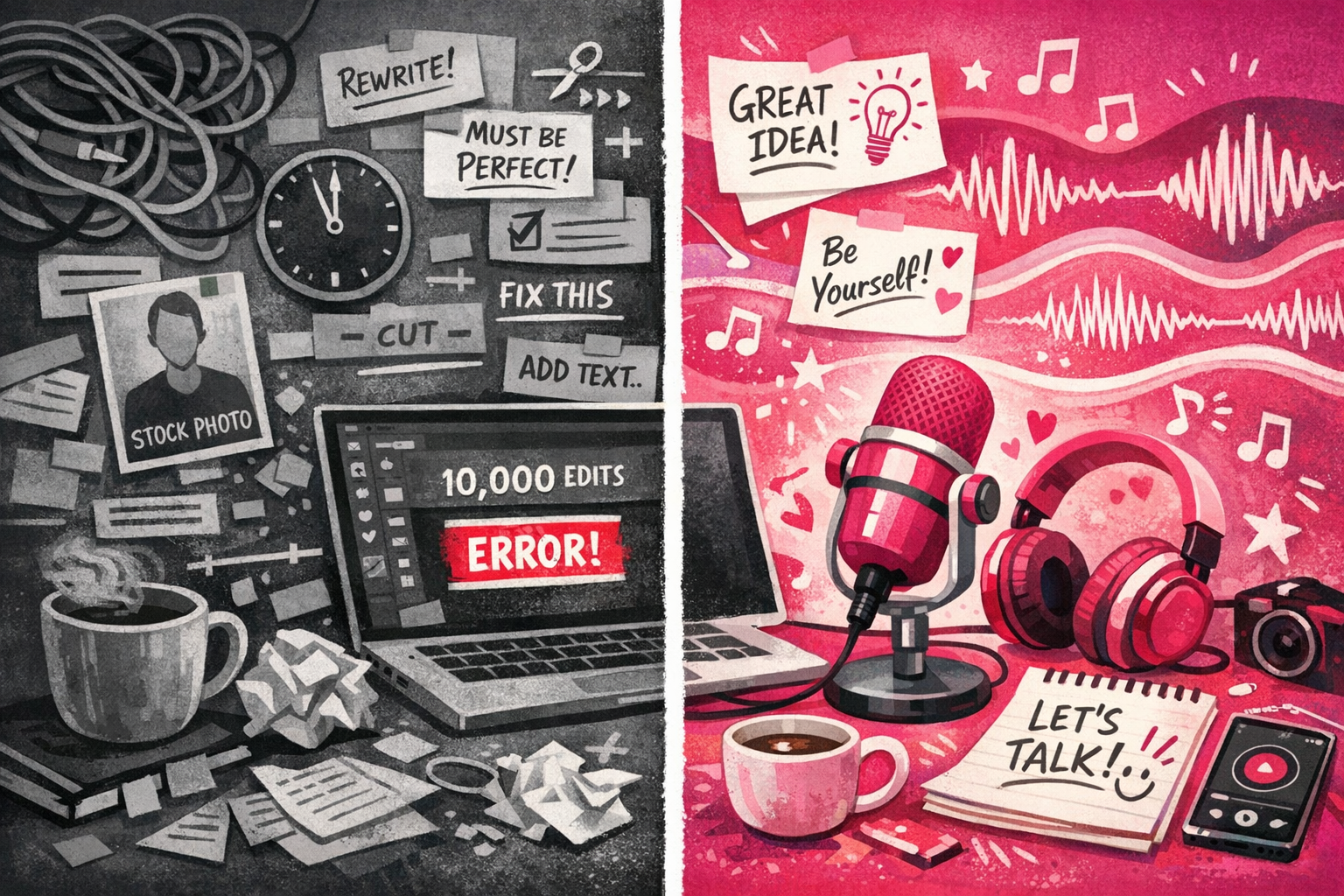
The moment you decide your podcast needs to sound professional, you’ve already lost. Not because professionalism is bad, but because that decision usually means you’ll start editing, re-recording, adding intro music you hate, and generally making the whole thing so much harder that you’ll quit.
I think perfectionism is the silent killer of podcasts. Not lack of time. Not lack of audience. Perfectionism. Because once you tell yourself the audio needs to be crisp, the pacing needs to be tight, and the content needs to be perfectly refined, you’ve added hours of friction to something that should take you fifteen minutes to publish.
Your competition are using slick, soulless ChatGPT posts because they’re not doing the highly human input. That takes effort. That takes showing up as yourself. But when you do show up, when you speak instead of write, when you let your actual voice come through, that’s your differentiator. That’s what people actually want.
Raw audio beats perfect silence
People don’t need polished. They need consistent. They need to hear from you regularly enough that they start to recognise your thinking patterns, your sense of humour, the way you phrase things. That’s familiarity. That’s trust. And it can’t happen if you only publish once every three months because each episode took you forty hours to produce.
The locked-in attention of a listener driving to work is gold. They can’t scroll away. They can’t skim. They’re just listening, thinking, building a picture of who you are. That’s the real value of audio, not the quality of the microphone, but the consistency of your presence.
Turn your videos into podcast episodes and you’ve immediately solved the production problem. The audio’s already there. It’s already you. Yes, it might sound a bit echoey from your room. Yes, you might stumble over a word. Yes, you might hear the distant sound of a dog barking. None of that matters. What matters is that next week you’ll do it again, and the week after that.
Permission to sound like yourself
I need you to hear this clearly: you do not need to edit, re-record, or improve the audio. You don’t need to worry about production value. You’re allowed to sound raw. You’re allowed to sound like you.
Many business owners find that the moment they give themselves that permission, everything changes. The friction disappears. The energy comes back. Suddenly you can turn your videos into podcast episodes without the emotional weight of feeling like it’s not good enough.
Your audience doesn’t need you to be perfect. They need you to be there. They need you to be human. They need the version of you that’s thinking out loud, not the version that’s been edited down to something so polished it could be generic.
Show up regularly. Give people a way to connect with you whilst they’re walking, driving, doing chores. That’s the entire game. Everything else is just noise.
How to turn one video into a podcast episode (without the extra work)
The reason most people don’t repurpose their videos into podcast episodes isn’t because it’s complicated. It’s because they’re waiting for permission to do it badly. They think there’s some standard they need to meet, some production checklist they haven’t ticked. There isn’t. You record video, you extract the audio, you add an intro beat and an outro beat, you upload it. That’s the actual process.
Here’s the friction-light version. When you’ve finished filming your video, export the audio file. Most editing software will do this in one click. If you’re using something like Descript, it’s built in. If you’re on your phone, there are apps that strip audio from video files in seconds. You now have an MP3. That’s step one, and it takes maybe two minutes.
Step two is the bit that makes it feel like a real podcast episode: a five to ten second intro beat and outro beat. Not a jingle. Not production. Just a simple, consistent piece of music that signals “this is a show.” I use Epidemic Sound for this. You get access to thousands of royalty-free tracks, download them, and drop them into your audio file. If you’re using Descript, you literally drag and drop. If you’re editing in Audacity or a browser tool, same thing. The beat goes at the start, your episode plays, the beat goes at the end. Five minutes of assembly, tops.
Making it repeatable
Here’s where the system comes in. If you do this once, you’ll have one podcast episode. If you do this twice by accident, you’ll have two. But if you systemise it, if you write down the steps, use the same file naming convention every time, have your links saved in a folder, have your music tracks pre-downloaded, it becomes something you can hand off or batch on a Friday afternoon while you’re thinking about something else entirely.
I think the real shift happens when you stop treating each episode as a special project. You’ve got a template. You’ve got a prompt in ChatGPT that generates your episode description and keywords. You’ve got your podcast platform links bookmarked. You’ve got your intro and outro beat in a folder called “Podcast Assets.” And then when you finish recording a video, the whole thing takes twenty minutes, including admin.
Where to publish
Most podcast platforms accept MP3 files and use RSS feeds to distribute to Spotify, Apple, and everywhere else. Anchor is free and owned by Spotify. Buzzsprout is paid but solid. Transistor is good if you want analytics. You plug in your MP3, add a title and description, hit publish, and it goes live everywhere. No extra work. No uploading to each platform individually.
If you want the full system for turning a live show into multiple formats, I’ve written The One Live Show Content System which covers the whole repurposing blueprint. But if you just want the step-by-step for turning one recorded video into a podcast episode with no extra production, Turn One Video Into a Podcast Episode walks you through it. Both are £9 PDFs. And if you want ongoing access to systems like this, The Strategy Lab is £4 a month on Skool and you get the full library.
But honestly, you don’t need any of that to start. You need the beat, the upload link, and the willingness to let it be simple.