
What to Put in a Brand Voice Prompt (Step by Step)
I see the same thing happen when business owners start using AI for content. The output sounds generic. Slightly off. Not quite you. So you tweak a few words, try a different prompt, and still spend longer editing than you would have done writing it yourself.
Most of the time, the tool is not the problem. The prompt is.
If I do not give AI a clear picture of how I actually think and communicate, it fills in the gaps with something average. That is why so much AI content feels flat. It is built on vague instructions.
In this article, I break down what to put in a brand voice prompt so the starting point is stronger. I cover the elements that actually shape voice, why loose descriptions lead to loose results, and how to build a prompt that reflects how you genuinely write and speak.
You do not need a 40-page brand document. You do not need a copywriting qualification. I think you just need to be more specific about things you already know but have never written down.
Key Takeaways
- A brand voice prompt needs more than adjectives like “friendly” or “professional.” I need to include specific examples, sentence patterns, and real context so the AI has something concrete to work from.
- The way I talk to my audience, including the words I choose and the ones I avoid, is more useful in a prompt than general descriptions of tone.
- Including my audience’s perspective, not just my own voice, helps the output feel relevant rather than one-sided.
- A good brand voice prompt is reusable. When I build it properly once, I have a starting point I can refine over time instead of reinventing it for every piece of content.
- The goal is not a perfect first draft every time. It is reducing the gap between what AI produces and what I would actually publish, so editing takes less effort.
Once I understand what belongs in a brand voice prompt, the whole thing feels practical. Less creative guessing. More clarity about what I am asking for and why. The rest of this article walks through it step by step.
Crafting a Brand Voice Prompt: Start with What You Say
Before you start drafting a brand voice prompt, look at what you’ve already said. Honestly. Your existing content is your clearest data source — it shows how you actually write, not how you imagine you write. And those are usually two very different things.
I see this all the time. We think we’re concise and bold. Then we read our own words back and realise we hedge. Or ramble. Or soften everything. The gap between intention and reality is bigger than we’d like to admit.
Do a Brand Voice Sample Analysis Before You Write a Single Prompt
Pull together a few pieces of content that felt easy to write or genuinely sounded like you. An email you didn’t overthink. A social post that sparked conversation. Maybe a video transcript where you were just talking and not trying to sound “on brand”.
Don’t pick the most polished pieces. Pick the ones that feel natural. The ones where you weren’t performing.
Once you’ve got them, read them back-to-back. Look for patterns. Are your sentences short and punchy, or do you let them run? Do you ask questions? Make blunt statements? Do you soften things with “perhaps” and “might”, or are you more direct than you realised?
Notice the words you reach for without thinking. The phrases you repeat. The habits hiding in plain sight. It’s oddly revealing.
This is where a tool like Claude can be genuinely useful. Paste in a few samples and ask it to pull out recurring patterns, tone markers, word choices. It won’t magically define your voice for you — and it shouldn’t — but it can spotlight traits you’re too close to see clearly.
What you’re building here is raw material. The foundations of a brand voice document. Without this step, any prompt you write is just guesswork dressed up as strategy. With it, you’re describing something real. Something that already exists.
A lot of business owners skip this. They jump straight to a list of adjectives they like the sound of. “Warm.” “Professional.” “Approachable.” I could apply those to half the internet. They don’t mean much on their own. They’re vague. Safe. And a bit forgettable, if I’m honest.
Authentic traits are specific. Sometimes slightly uncomfortable. Definitely not aspirational fluff.
When you’ve done this analysis, you don’t just have ideas — you have evidence. So take fifteen minutes. Pull three or four pieces of your own content and read them back-to-back. That’s it. That’s the first step to making your AI sound human. And it happens well before you open any AI tool.
Specificity Wins: Defining the Heart of Your Voice
When you’re thinking about what to put in a brand voice prompt, the single biggest mistake I see is vagueness. Words like “professional”, “friendly”, and “authentic” feel right. They sound sensible. But they mean almost nothing to an AI — and honestly, not much to a human writer either. Specificity is what separates a prompt that gives you something usable from one that produces beige, forgettable content you’ll immediately want to rewrite.
Choose Voice Adjectives That Actually Mean Something
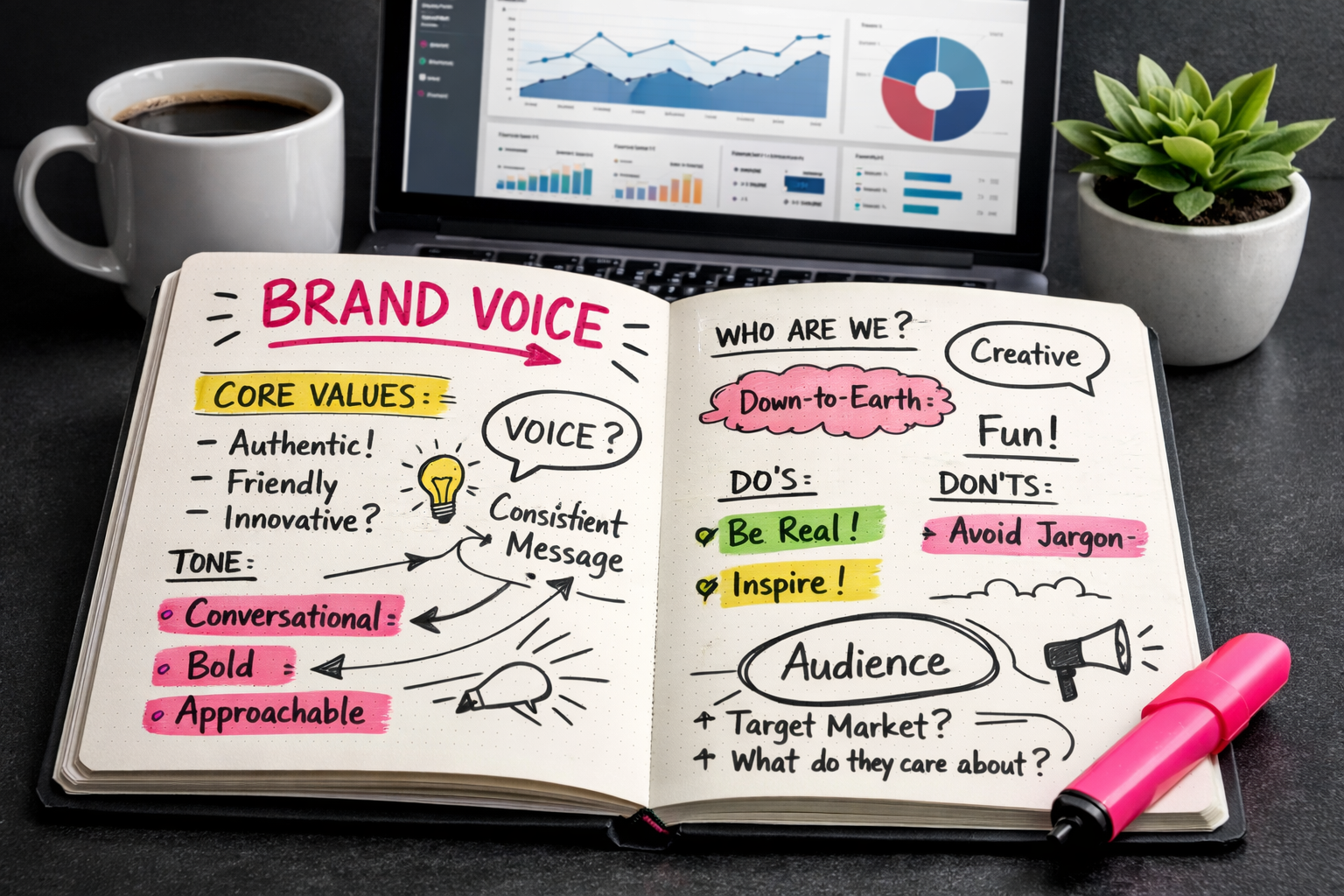
Start by distilling your brand voice into three to five adjectives — but don’t stop there. This is where most people stop. Each adjective needs something concrete behind it. “Warm but direct” is useless on its own. It only becomes helpful when you show what warm-but-direct actually sounds like in a sentence.
Here’s what makes a voice adjective worth keeping in your brand voice document:
- It’s specific enough to rule things out — “conversational” doesn’t; “casually knowledgeable, like a trusted colleague” does
- It has an opposite you’d genuinely reject — if you can’t clearly say what your voice isn’t, it’s probably too broad
- You can demonstrate it with a real phrase or sentence — examples anchor meaning in a way definitions just don’t
- It reflects how your actual customers describe you — analysing your reviews and DMs is often the quickest shortcut here
- It holds up across different content types — an email, an Instagram caption, and a sales page should all feel like the same person wrote them
Once you’ve got your adjectives sorted, build guardrails around them. A do/don’t list is one of the most practical things you can add to your brand voice document because it forces you to get specific. No hiding behind vague principles.
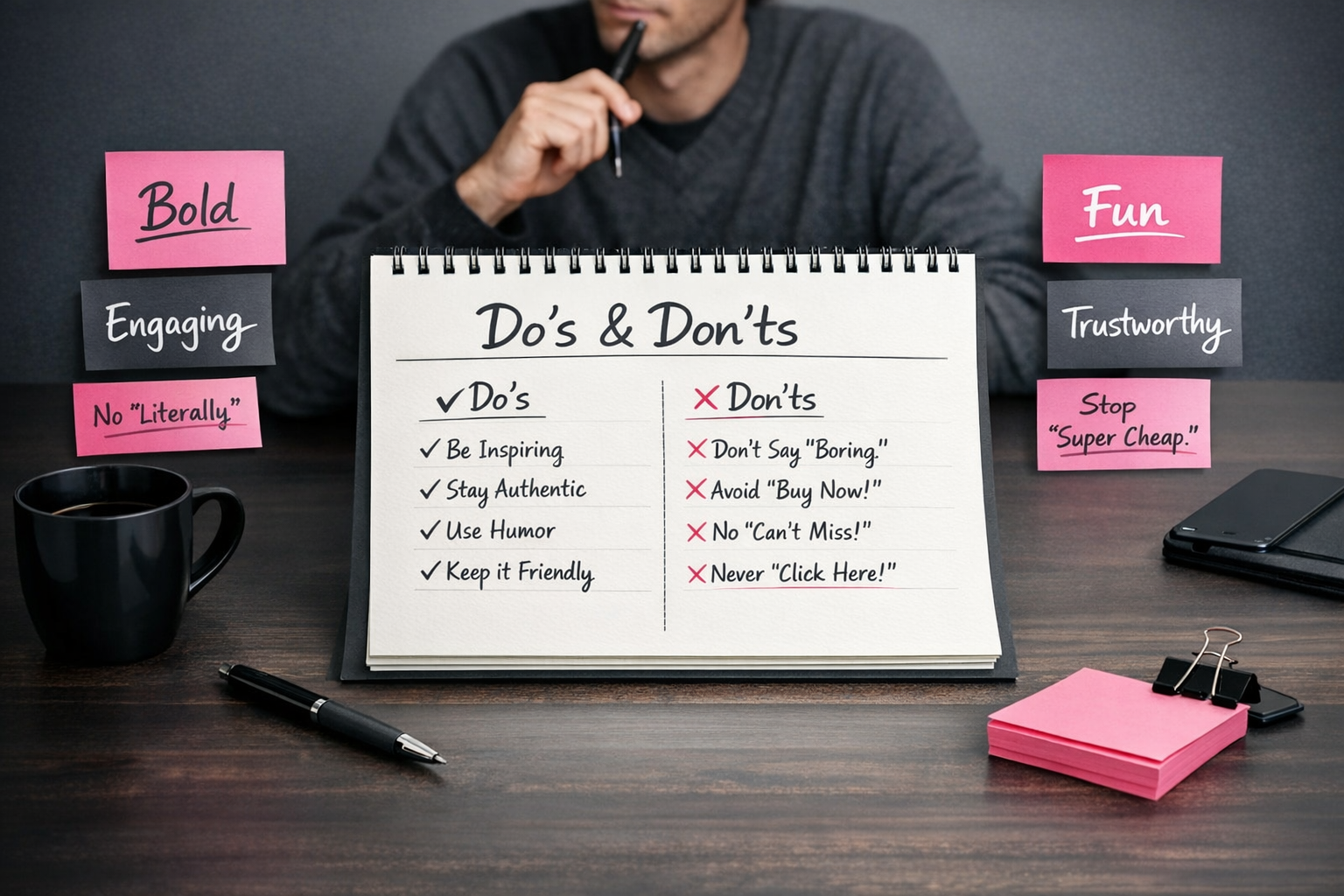
And honestly? Your “don’t” list is usually more powerful than your “do” list. Banned phrases are gold. If you’d never say “leverage synergies” or “circle back”, write that down. AI tools are trained on mountains of corporate language. If you don’t draw a line, they’ll default to the exact phrasing you’re trying to avoid. And then you’re back to editing, tweaking, fixing. Again.
This isn’t about writing rigid rules. It’s about teaching instinct. About showing the boundaries. Humanising your brand’s AI output starts here — not in the tool settings, but in the clarity of what you give it. The more tightly you define the edges of your voice, the more freedom AI actually has to help. Otherwise, you’ll spend twenty minutes turning something technically fine into something that actually sounds like you.
Your next step: open a blank document and draft your first do/don’t list. Five entries on each side. Don’t overcomplicate it. Start with the phrases that make you physically cringe when you see them in your own drafts — you know the ones — and work backwards from there.
Humanising Your AI Output: Crafting the Right Prompts
Knowing what to put in a brand voice prompt is the difference between AI that sounds like you and AI that sounds like everyone else on LinkedIn. Most business owners either give it almost nothing, or they type “write in a friendly tone” and then act surprised when it spits out something bland. Of course it does. This section is about fixing that — practically, step by step.
Feed It Your Real Voice, Not a Description of It
Start by giving the AI actual samples of your writing. Not a list of adjectives. Not “confident, warm, approachable.” Real sentences. Paragraphs you’ve actually written. Grab something from an email, a post, a page on your website that you genuinely like. That’s the foundation of any proper brand voice sample analysis. You’re giving it something solid to mirror instead of forcing it to guess.
Then tell it what those samples are doing. For example: “This is how I write when I’m explaining something complicated to a small business owner who’s short on time.” That line alone adds so much clarity. You’re not just dropping text in and hoping for the best — you’re giving tone guidance with context. And context changes everything.
Next, layer in your audience persona. Keep it simple. “My reader runs a small service business, they’re experienced but fed up with jargon.” That single sentence will shape the output more than most people realise. Optimising brand voice with AI isn’t about clever settings or secret hacks. It’s about giving the model enough human detail to make better calls.
Add Emotional Benchmarks and What to Avoid
One of the most useful things you can add is a quick “sounds like / doesn’t sound like” list. For example:
- Sounds like: a direct conversation over coffee, plain words, active voice, a little dry humour
- Doesn’t sound like: corporate speak, motivational posters, filler phrases like “in today’s fast-paced world”
- Metaphors I use: I often compare marketing decisions to editing — cutting what doesn’t serve you
- Emotional register: reassuring but honest, never hype, never condescending
This is where most people get lazy, I think. They stop at “friendly and professional” and hope for magic. But this kind of emotional benchmark is what actually makes it work. Humanising your brand’s AI output comes down to specificity. The clearer you are about the feeling of your writing, the less the AI has to fill in the gaps — and it will fill them in, whether you like it or not.
It’s almost like building a tiny brand voice document inside the prompt itself. Not complicated. Just honest and precise.
Keep refining as you go. This isn’t a one-and-done exercise. It’s a loop. Generate something. Read it out loud. Notice where it feels stiff or weirdly over-enthusiastic. That’s feedback. Add a line: “avoid exclamation marks” or “don’t start sentences with ‘Additionally’.” Nudge it back into your lane.
The goal isn’t perfection. The goal is a prompt you can reuse, tweak slightly depending on the task, and trust to give you something that feels like a first draft from you — not a stranger who skimmed your website once.
Your challenge this week: write one sample prompt using your own writing as the source material, a brief audience persona, and at least one “doesn’t sound like” instruction. Test it on something low stakes — a short email or a social caption — and pay attention to what changes.

The Iteration Process: Tweaks and Team Alignment
Getting clear on what to put in a brand voice prompt is only half the job. The other half? Checking if it’s actually landing — and adjusting when it’s not.
Testing Your Brand Voice Before You Assume It’s Working
The most common mistake I see is treating a brand voice document like it’s “done” the second it’s written. It’s not. It’s a working theory until your content proves it works. I’d start by running a few simple QA prompts — give your AI tool the same brief in different ways and see if the output genuinely sounds like you each time.
Brand voice sample analysis doesn’t need to be complicated. Pull five to ten recent pieces of content — emails, social posts, a web page — and ask yourself, honestly, do these sound like the same person wrote them? If not, something’s missing. Usually it’s a clear boundary, a phrase you keep meaning to avoid but haven’t stated, or a specific example of how you handle something nuanced.
Audience surveys are wildly underused here. And I think that’s a mistake. A short, three-question survey asking readers how they’d describe your tone can show you gaps you simply won’t see yourself. You’re not asking for a full critique. You’re checking whether what you think you’re putting out is what people are actually picking up.
Refining Over Time Without Losing the Thread
“How do I refine my brand voice without messing it up?” comes up a lot once people have a prompt that sort of works. My honest answer: treat it like A/B testing, not a dramatic rewrite. Change one thing at a time — the warmth, the directness, the level of formality — and watch what shifts before you touch anything else.
If you’ve got a team, this is where things quietly unravel. One person uses the full prompt. Someone else shortens it. Another ignores it because they “get the vibe”. That’s how drift happens. A short workshop — even an hour — where everyone reads the same piece aloud and calls out what feels right or off can do more for consistency than a glossy document ever will. You’re building shared instinct, not just sharing a file.
As you grow, having someone act as brand guardian is worth thinking about. It doesn’t need to be a fancy title. It just means someone owns the question, “Does this still sound like us?” Optimising brand voice with AI works beautifully — but only if there’s at least one human paying attention who actually knows what “us” means.
And yes, brand voice trends shift. What felt warm and fresh last year can start to feel a bit copy-and-paste when everyone’s using the same phrasing. I think revisiting your creating a brand voice document process once or twice a year keeps it honest. Not to chase trends. Just to check you still sound like you — not like a template you downloaded and forgot to question.
Humanising your brand’s AI output isn’t a one-and-done task. The prompt gets you most of the way there. The iteration — the testing, the nudging, the paying attention — is what finishes the job.
If you haven’t already, consider running a short brand voice survey with your audience or getting your team in a room for a quick voice alignment session. Even an informal conversation about what feels right can surface more clarity than weeks of tinkering on your own.

Sources:
“Sprinklr” (undated)