

Introduction
That free PDF sitting permanently on your website often feels useful. It ticks a box. It gathers a few emails. Then it just sits there.
When I look at evergreen vs time-limited lead magnets, I see most people default to “create it once and leave it up forever”. It feels efficient. It feels sensible. But I think it quietly costs more than it saves.
Urgency changes how people behave. Evergreen content feels practical, but time-limited offers usually drive more action. Not because they’re manipulative. Because they reflect how decisions actually get made. Without a reason to act now, people simply don’t.
In this article, I’ll break down why time constraints often beat permanence, how static content can drain momentum from your marketing, and how I approach rotating lead magnets without turning it into a full-time job.
Key Takeaways
- Time-limited lead magnets usually outperform evergreen ones because they use clear deadlines and scarcity. That nudge pushes decisions instead of leaving space for endless procrastination.
- Evergreen lead magnets often become digital wallpaper. Repeat visitors stop seeing them, and over time they can make a brand look static rather than active.
- Rotating lead magnets across the year creates multiple entry points into your world while keeping the urgency that drives conversions.
- Authentic urgency matters. Fake scarcity ruins trust. Time limits need to make real-world sense, like seasonal content, live sessions, or fixed enrolment periods.
- The right systems make this manageable. I focus on reusable frameworks and simple templates so I’m not rebuilding everything from scratch each time.
If I’m going to put effort into a lead magnet, I want it to work properly. So it’s worth looking at what actually moves people to act, rather than what simply looks tidy on a website.
Why Time-Limited Lead Magnets Rule the Marketing Game
When it comes to Evergreen vs Time-Limited Lead Magnets, I’ve watched a clear winner pull ahead. Time-limited offers consistently beat the “always there” downloads when it comes to real engagement and actual conversions. Not vanity numbers. Actual action. And in 2026’s noisy, crowded online world, I think urgency matters more than ever.
The Psychology of Urgency Drives Action
The benefits of time-limited lead magnets aren’t complicated. They’re human. We respond to scarcity. We respond to deadlines. When something might disappear, our brain flags it as important. When it’s permanently available? It drops down the list.
In fact, that’s not manipulation. It’s just how decisions work. Endless choice slows people down. A clear window helps them decide.
Here’s why time constraints consistently outperform evergreen offers:
- They cut through decision paralysis by forcing a yes or no
- They reduce the “I’ll do it later” effect (which, let’s be honest, usually means never)
- They give you natural reasons to talk to your audience
- They create defined campaign timelines with clear metrics
- They stop your offer fading into background noise
Crucially, one of the biggest disadvantages of evergreen lead magnets is this: they become part of the scenery. Always there. Rarely noticed. Like a billboard you pass every day and couldn’t describe if someone asked.
How to create urgency honestly
And creating urgency doesn’t mean flashing countdown timers or shouting at people. It can be simple. Honest. “This workshop runs until Friday.” “I’m taking 20 people.” That’s it. Clear boundaries. Clear expectations. Adults talking to adults.
If you’ve got a small audience, especially, I often think rotation works better than permanence. One evergreen PDF sitting there for three years? It goes stale. Rotating limited-time offers keeps things alive. It gives you multiple entry points. It gives people a reason to pay attention again.
There’s something energising about a live window too. It feels different. More focused. Even if the content itself isn’t radically different.
Rotating lead magnets also gives you real data. Each campaign becomes a contained test. You see what gets clicks. What gets replies. What actually converts. Instead of committing forever to something that might just be… fine.
The biggest mistake I see? Believing your audience needs permanent access to everything. They don’t. Honestly, none of us do. We appreciate being told what matters now.
When you use time-limited lead magnets properly, you’re not just pushing urgency. You’re creating focus. And in a world drowning in content, focus is the thing that cuts through.

How Static Content Drains Your Marketing Efforts
You’ve probably got that dependable PDF guide or checklist sitting on your website. The one you made ages ago. It quietly collects email addresses and mostly behaves itself.
But is this “evergreen and done” approach actually costing you engagement? I think for a lot of businesses, yes. More than they realize.
The Hidden Costs of “Set It and Forget It” Lead Magnets
When it comes to evergreen vs time-limited lead magnets, most people default to evergreen because it feels efficient. Create it once. Use it forever. Job done.
Except… it’s not that simple.
Content decays. Slowly, quietly. Trends shift. Tools change. Buyer problems evolve. What felt sharp and useful when you wrote it can start to feel a bit dusty. Maybe nothing’s technically wrong with it. But it’s not current. And when your lead magnet feels dated, you look dated. That’s the bit no one talks about.
Then there’s diminishing returns.
Your core audience has probably already seen — and downloaded — your permanent freebie. So every time they land on your site and see the same thing, it blends into the background. It becomes digital wallpaper. There’s actually a name for it: banner blindness. People just stop registering it.
And the impact doesn’t stop there.
If someone downloads your lead magnet, goes through your welcome sequence, and then… nothing new appears for months? They disengage. Open rates drop. Curiosity fades. Unsubscribes creep up. Not because your content is bad, necessarily. But because there’s no freshness. No reason to lean in again.
The disadvantages of evergreen lead magnets reach into brand perception too. When the same offer sits there year after year, it subtly suggests you’re not evolving. Not creating. Not moving. And maybe that’s not true. But perception matters.
Time-limited offers, on the other hand, create natural urgency. Static content just can’t compete with that. Scarcity — real, defined scarcity — changes behavior. Limited windows. Rotating offers. Defined access periods. These things consistently convert better than something that looks like it will be available forever.
Warning Signs Your Evergreen Strategy Needs a Shake-Up
If you’re unsure whether your evergreen strategy is due a shake-up, here are some warning signs:
- Your opt-in conversion rate has steadily declined
- Email open rates drop significantly after the initial welcome sequence
- You’re getting fewer questions or engagement from new subscribers
- Your unsubscribe rate is climbing while sign-ups plateau
- You haven’t updated the content in over 12 months
That last one matters more than people think.
The answer isn’t to scrap evergreen content entirely. I’m not anti-evergreen. I’m anti-stale. There’s a difference.
A rotational strategy often makes more sense. Cycle different lead magnets throughout the year. Keep the core assets, but change what’s front and centre. You still get the efficiency of reusable content, but you layer in urgency and freshness.
And especially with smaller audiences, rotation gives you multiple chances to connect with the same people in different ways. Different entry points. Different angles on your expertise. Without burning yourself out creating endless new stuff.
It’s not about doing more.
It’s about not letting your marketing sit still.
Building Urgency: The Key to Higher Conversions
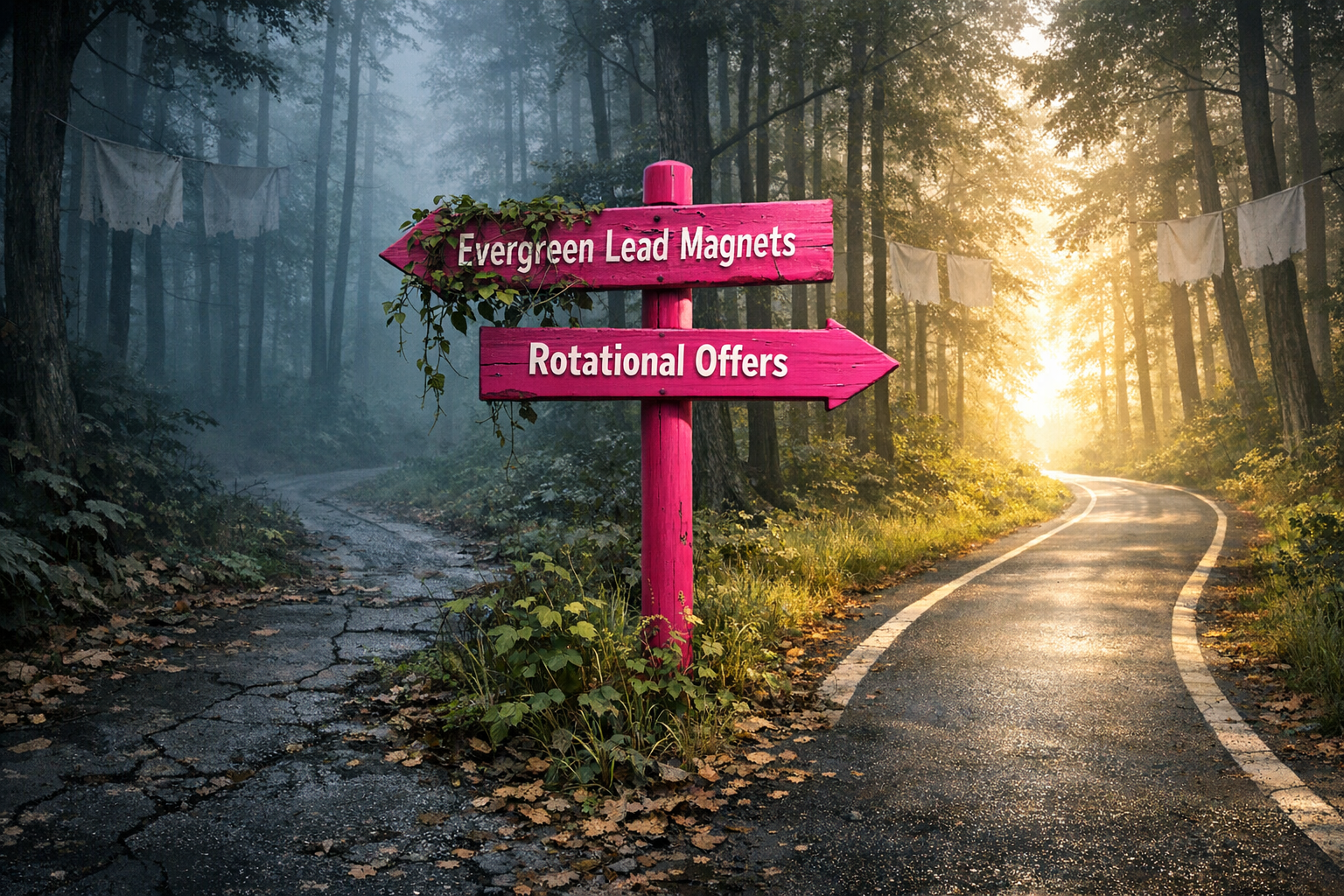
When you look at evergreen vs time-limited lead magnets, urgency is usually the thing that moves the needle. Not the design. Not the clever headline. Urgency.
I’ve watched businesses shift their results just by putting a deadline on something that used to sit there forever. And it’s not complicated psychology. We’re wired for scarcity. We don’t like missing out. Call it FOMO if you want, but really it’s just how humans make decisions.
The Psychology of Now or Never
Urgency works because it changes the question.
It stops being “Should I get this?” and becomes “Should I get this now?”
That one word matters. “Now” cuts straight through procrastination. Left to our own devices, we’ll save it, think about it, open another tab, forget about it entirely. But when something might go, suddenly the brain pays attention.
The benefits of time-limited lead magnets come from that shift. Nothing mystical. Just behavioural science doing its thing:
- They give people a clear deadline to decide
- They remove the “I’ll come back later” trap
- They hand someone a reason to act today
- They increase perceived value (limited usually feels more valuable — that’s just how we’re built)
It’s not manipulation. It’s momentum.
Making Urgency Authentic
Here’s where people get it wrong. Fake scarcity.
Nothing kills trust faster.
If your lead magnet is “closing tonight” but mysteriously reopens every single week, people clock on. And once that trust dips, it’s hard to win back.
Real urgency has to make sense. A seasonal guide. A live workshop with capped spaces. A resource that genuinely needs updating and can’t sit out there forever. The issue with evergreen lead magnets isn’t that they’re bad — it’s that they often lack a natural reason to act now. They’re always there. So people treat them that way.
For smaller audiences especially, rotating your lead magnet can feel fresher and more honest. You’re not pretending something’s scarce. You’re simply not offering everything all the time. Different windows. Different focuses. It keeps the energy moving.
Countdown timers, limited enrolment periods, seasonal relevance — they’re tools. Useful ones. But only if they’re tied to something real.
And I think that’s the line. When urgency reflects genuine value and genuine limits, conversions go up because the decision feels clear. When it’s theatre, people can feel that too.

Streamline Your Strategy: How to Efficiently Rotate Offers
Let’s be honest about lead magnets. Whether you’re team evergreen or team time‑limited, that’s not actually the hard bit. The hard bit is running them consistently without creating a second full‑time job for yourself. Especially if your audience is small and every click, every reply, every new subscriber actually matters.
Automation: Your Secret Weapon
Marketing automation isn’t just for the big brands with huge teams. If anything, it matters more when you’re small and doing most of this yourself. The real advantage of a platform like GoHighLevel is that it lets you build the engine once — landing pages, forms, email sequences, follow‑ups — and then duplicate the structure when you rotate your offer. You’re swapping content, not rebuilding the machinery every single campaign.
If you’re serious about using urgency properly, that infrastructure matters. With something like GoHighLevel’s all‑in‑one system, delivery, nurturing, tagging, and even CRM tracking live under one roof. That means when you close a time‑limited lead magnet and open the next one, the process stays clean. No scrambling. No patching tools together. Just a controlled rotation.
Rotating lead magnets without the workload
Rotating lead magnets for better results doesn’t have to mean more work. It often feels like it will. It doesn’t need to. Here’s what makes it manageable:
- Create a master template for your landing pages with placeholders for headlines, benefits, and images
- Build a reusable email sequence that works for any lead magnet delivery
- Develop a content calendar that plans your rotations quarterly, not weekly
- Use A/B testing to compare evergreen and time-limited offers with the same audience
This is exactly where having a central system helps. When your templates, automations, and contact records sit in one place, rotating offers becomes a strategic decision — not a technical headache.
The downsides of keeping everything strictly evergreen are usually the same: it goes stale, and there’s no urgency. People can come back “later”. And we all know what later means. A simple rotation system, supported by the right infrastructure, gives you the urgency and freshness of time‑limited offers without blowing up your workload.
I don’t think the answer is picking one type and declaring it the winner forever. It’s building systems that can handle both. That way you get to test what actually moves your audience — not what some marketing blog says should work in theory.
And honestly? Your tools should make this simpler, not more complicated. If you’re building a more robust funnel around rotating offers, having everything housed inside a single platform like GoHighLevel means urgency doesn’t turn into chaos. You don’t need a perfect system — you need consistency and your offers in front of people. The rest can evolve as you go.

Sources:
Influence, New and Expanded (Cialdini, 2021)