

You’re ready to launch your first funnel. Instead, you’re stuck thinking about the sales page. Should it be long or short? What needs to go on it? What if you get it wrong?
I see this a lot. People spend weeks tweaking a page before they even know if the offer works. It feels productive, but often it just delays the launch.
Here’s the truth. Your first funnel might not need a full sales page at all. In many cases, **simpler** works better. I want to walk you through what actually matters so you can get your funnel live without overcomplicating it.
Key Takeaways
- Your first funnel needs three essentials: an offer people want, a way to collect email addresses, and a delivery method. Everything else is optional.
- Trust comes before transactions. I focus on growing an email list and giving real value before pushing for the sale.
- Simple tools like MailerLite, ConvertKit or an all-in-one platform like GoHighLevel are more than enough to launch a solid first funnel.
- I can test demand with a simple lead magnet before investing time in a full sales page. It saves money and stops me polishing something no one has asked for.
- The best first funnel is the one I actually launch. Done beats perfect. Every time.
If I keep this **simple** and focus on what matters, the whole thing starts to feel lighter. That’s the point.
Do you really need a sales page for your first funnel?
Let’s just say it plainly: no. You absolutely do not need a sales page for your first funnel.
I’ve watched so many business owners stall because they’re tweaking headlines and moving buttons around on a page that isn’t even live yet. They’re waiting for “perfect.” And honestly? Waiting is usually the bigger mistake.
What you actually need is much more basic. An offer people actually want. A way to collect email addresses. A way to deliver what you promised. That’s it.
The long, beautifully designed sales pages, clever automations, and layered upsells? All optional. All later.
Why simpler funnels often work better for beginners
The best first funnel? The one you launch.
I think we underestimate how much energy gets burned trying to perfect something no one has even seen. Months on a sales page. Endless revisions. Tiny tweaks that feel important but change nothing because… it’s not live.
At the start, your real job isn’t building a masterpiece sales page. It’s building attention and trust. Growing your email list. Starting conversations.
A complicated page won’t rescue an offer nobody wants. And it definitely won’t fix a cold audience.
Sales funnel basics for beginners are simple on purpose. Complexity feels productive, but it usually just slows you down. When you’re new to funnels, you need movement. You need feedback. You need momentum. Perfection is irrelevant at this stage.
What to use instead of a sales page
Here’s what can replace a traditional sales page in your first funnel:
- A straightforward landing page with your core offer and a buy button
- A well-written email sequence that builds trust before you make the ask
- A scheduled Zoom call where you explain the offer live
- A simple product page on your existing site
- Even just a Stripe or PayPal payment link sent directly to interested buyers
Do beginners need a sales page? Only if it helps more than it hinders.
If building it means you disappear into a design spiral for three months, then no. Clearly not.
There’s something underrated about keeping it simple at the start. When you build a basic email funnel first, you get something far more useful than a polished page: real responses from real people.
Your first buyers will tell you what clicked. What made sense. What almost stopped them. That information is gold.
And then, when you do create a sales page, it isn’t guesswork. It’s built from language that already proved itself.
So the real question isn’t “do you need a sales page for your first funnel?”
It’s this: what’s the simplest way to start generating results and revenue right now?
Start there. Add complexity only when simplicity genuinely stops working — not before.
When skipping the sales page is the smarter move
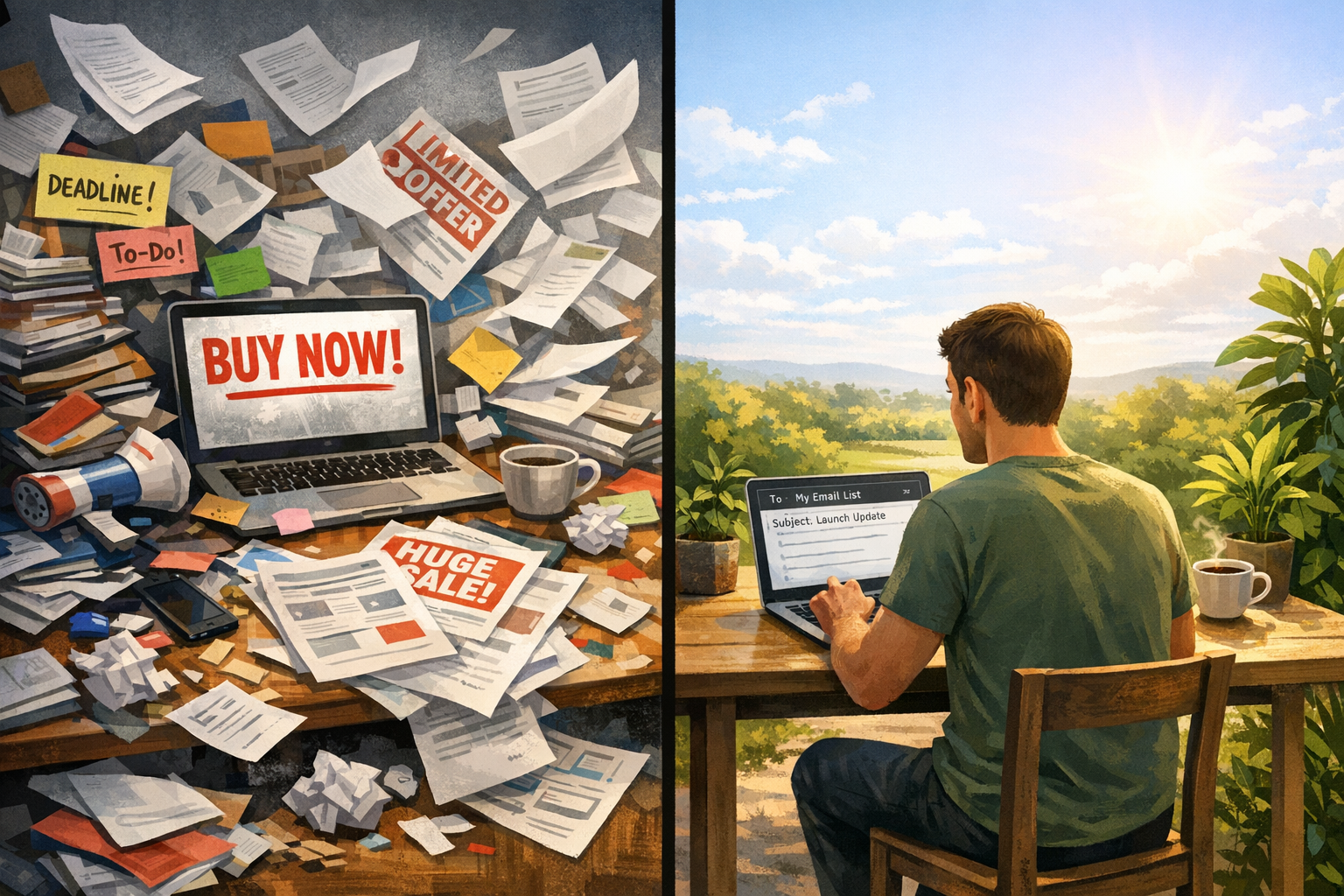
Do you really need a sales page for your first funnel? Honestly? Probably not. I see business owners lose weeks polishing sales pages for offers nobody’s actually asked for yet, when their time would be far better spent elsewhere.
Let’s be honest about what usually happens with first funnels. You build a beautiful sales page. Strong headline. A few testimonials (even if you’re stretching for them). Nice images. Big confident buy button. You hit publish.
And then… nothing.
Testing demand before building infrastructure
Here’s the uncomfortable bit: building a sales page before you know people want the thing is premature optimisation. Especially if you’re at the beginning and quietly asking yourself whether you even need a sales page at all. You’re building the final layer of the machine before you’ve checked anyone wants what’s coming out of it.
Your first funnel without a sales page is often the smarter move. Instead of jumping straight into “sell mode”, create a simple opt-in that delivers something useful and helps you:
- Validate your audience exists
- Confirm people care about the problem you solve
- Build a relationship with potential customers
- Test your messaging before sinking time into sales copy
- Collect email addresses for future launches
It sounds basic. It is basic. That’s the point.
Start with a lean funnel that builds trust
What do you actually need to start a sales funnel that works? Connection before conversion. A simple email sequence behind a genuinely useful lead magnet will teach you far more about your market than a sales page no one’s landing on.
This isn’t “doing it the cheap way”. It’s validation. There’s a big difference. I’ve watched people spend months tweaking headlines and button colours on offers that really needed better positioning, clearer outcomes, maybe even reshaping entirely after a few proper conversations.
And if I’m honest, I think we often hide in the sales page because it feels productive. It looks like progress. But sometimes it’s just busywork dressed up as strategy.
Your early funnel data — who signs up, who opens, who replies, who ignores you — is far more valuable than a perfectly designed page. When real humans are engaging, clicking, replying, then you build the sales layer around what’s actually landing.
The basics aren’t complicated: give before you ask. Build trust. Watch what resonates. Then create a sales page that speaks directly to a need you already know is there — instead of hoping it is.

What you actually need to launch your first funnel
Do you really need a sales page for your first funnel? No. You don’t.
You can launch something that works with far less moving parts than the internet would have you believe. Let’s separate what’s essential from what’s just… noise.
The simplest effective funnel has three things:
- A landing page offering something genuinely useful.
- A thank you page that delivers it.
- A welcome email that starts the conversation.
That’s it.
This is sales funnel basics for beginners. No sprawling tech stack. No twelve-email automation mapped out on a whiteboard. Just the core pieces that actually move someone from “who are you?” to “okay, I’m listening.”
The three-part starter funnel that actually works
What do you actually need to start a sales funnel that converts? Honestly, less than most “experts” make you think.
Your landing page needs to clearly explain what someone gets when they hand over their email. Not waffle. Not clever copy gymnastics. Just clarity.
Your thank you page? Deliver what you promised and give one clear next step. One. Not five.
And your welcome email should build on the relationship by giving more value. No hard sell. No pressure. Just useful, human communication.
This works for a simple reason: landing pages convert better than cold sales pages. People will happily exchange an email address for something helpful. Buying from someone they discovered five minutes ago? Not so much. That part comes later.
Tools like ConvertKit, MailerLite or GoHighLevel make this easy. They’ve got templates. Use them. You do not need to build from scratch to prove a point. If you like everything connected — pages, emails and basic CRM under one login — an all-in-one can keep your starter funnel clean without duct-taping tools together.
Pick one platform. Learn the bits you actually need. Ignore the shiny features. Most funnel faff comes from clicking around inside tools instead of focusing on the message.
Build trust first, sell second
When you’re figuring out how to build a simple email funnel, remember this: the goal of your first funnel probably isn’t instant sales.
It’s trust.
It’s building a list of people who are happy to hear from you again.
Your thank you page is often overlooked, which I find interesting. It’s prime real estate and people treat it like a receipt page. Add one clear next step. Join your social channels. Book a call. Look at a low-priced offer. Something intentional.
That small shift can massively increase how engaged people are with your welcome email and everything that follows.
I’ve watched business owners delay for months trying to perfect elaborate sales pages and intricate automations. Meanwhile, others with a basic three-part funnel are collecting leads, building relationships and making actual sales.
The truth? Imperfect action beats perfect planning. Every time.
You just need enough to start collecting emails and building trust. The rest can evolve once you’ve got movement. Motion creates clarity. Not the other way round.

Why email subscribers matter more than early sales
Do you really need a sales page for your first funnel? Honestly, no. And here’s what a lot of funnel builders won’t say out loud: when you’re just starting, growing your email list matters far more than squeezing out a few early sales.
If you’re a coach, consultant or creator, trust comes before transactions. Always. Early on, you don’t have a sales problem. You have a visibility and credibility problem. Different thing entirely.
Building an owned audience beats algorithm dependency
Your email list is an asset. You own it. Fully.
Unlike social media followers, there’s no algorithm update waiting to quietly throttle your reach. No platform deciding who gets to see you today. When someone joins your list, they’re choosing to hear from you. That’s powerful.
And subscribing isn’t the same as buying. It’s not a yes to a payment page. It’s more like, “I’m interested. Keep talking.” That’s a door opening, not a deal closing. And I think we forget how valuable that is.
In 2026, with everyone shouting online, that permission to land in someone’s inbox? It’s rare. It’s precious. It cuts through in a way social posts just don’t.
Email still delivers the highest ROI of any digital channel, even as we edge towards 2027. For every £1 spent, returns consistently outpace paid ads and most social campaigns. Not because it’s flashy. Because it’s direct. Personal. Owned.
Starting simple with the right tools
You do not need a complicated tech stack to collect and nurture leads. You just don’t.
These tools keep it simple:
- MailerLite or ConvertKit — clean, intuitive, ideal if you want straightforward opt-in forms and a basic automated welcome sequence
- GoHighLevel — useful if you prefer everything connected from day one, rather than stitching tools together later
That’s it. No drama.
A simple email funnel gives you space to focus on what actually matters: building real connection. Sales funnel basics for beginners don’t require elaborate sales pages or clever psychological triggers. They require thoughtful communication.
Instead of obsessing over whether you need a sales page for your first funnel, ask better questions.
What problem can you help a new subscriber solve in their first week? What would make them feel genuinely supported? How can you show you know your stuff without immediately reaching for the card details?
Relationship-based selling starts with connection. Not tactics, not countdown timers, not pressure.
The subscribers who feel understood and helped today become the buyers who trust you tomorrow. And I’d take that over a fast, awkward early sale any day.

The hidden cost of building a sales page too soon
When you’re just starting out, do you really need a sales page for your first funnel? That polished page feels like progress. It looks impressive. It gives you something concrete to point at and say, “Look, I’m building my business.”
But if I’m honest, it’s often a very expensive distraction from what actually matters.
A proper sales page isn’t cheap. Good copy alone can run into the thousands. Then there’s design, tech, integrations. It adds up fast. And that’s a big investment for something that might not convert. Or worse, something no one really wanted in the first place.
The premature optimisation trap
Here’s the bit people don’t like hearing: if your offer doesn’t resonate, even the most brilliant sales page won’t rescue it. The words can be perfect. The design flawless. Still won’t fix a weak or untested offer.
I keep seeing business owners pour weeks (and serious money) into perfecting sales pages for offers that haven’t been validated. And then… silence. No sales. Hardly any clicks. Just a very shiny page sitting there doing nothing.
Most new websites get barely any traffic. So your beautifully crafted page might sit quietly for months, attracting a trickle of visitors. Not enough sales to feel good. Not enough data to learn from. Just… ambiguity. And that’s frustrating.
This is premature optimisation. Polishing before proving. Tweaking before testing. And once you’ve sunk that time and money into it, it’s hard to let go. Even when the signs are pretty clear. The sunk cost fallacy is real, and it keeps people stuck longer than they need to be.
A smarter way to approach your first funnel? Keep it simple. Use lightweight lead magnets to test demand before you commit to a full sales page.
For example:
- A basic landing page with email signup
- A free mini-course delivered via email
- A single-page PDF with valuable insights
- A waitlist for your developing offer
None of these require a huge investment. They give you faster feedback. And they help you see what your audience is actually responding to.
You’re building your list either way, which is never wasted effort. And when you do create a sales page later, you’re not guessing. You’re not hoping.
You know there’s demand.

How to keep your first funnel tech stack ridiculously simple
Do you really need a sales page for your first funnel? Maybe. Maybe not. But what will surprise you more is how little you actually need to get started.
When I talk to overwhelmed business owners, it often feels like they’re buried under tools they didn’t even want. Signed up because some loud “expert” said it was essential. Spoiler: most of it isn’t.
The minimum viable funnel system
Let’s just say it plainly: you do not need twelve platforms to launch your first funnel.
What do you actually need to start a sales funnel that works?
- A simple page builder for opt-ins and thank you pages
- A reliable email marketing tool to send your emails
- A basic CRM to keep track of leads and customers
That’s it. Truly.
Everything else is optional. Nice, perhaps. Necessary? No. The basics are simple on purpose. Because complexity doesn’t make you clever. It makes you stuck.
All-in-one vs. à la carte approach
The SaaS sprawl is real. One tool for this. Another for that. Monthly payments stacking up while you’re still trying to remember your passwords.
An all-in-one like GoHighLevel can simplify things massively. Landing pages, email automation, CRM — all in one place. Fewer tabs. Less faff. If you know you’ll eventually want those pieces connected anyway, starting inside one system can save you an awkward migration later.
If you prefer flexibility, pairing something like ConvertKit with Leadpages works perfectly well too. There’s no moral superiority here. The point is choosing tools that can grow with you so you’re not forced into some dramatic migration six months from now.
And yes, your first funnel might not have a sales page at all. It might just be a lead magnet form triggering a short email sequence. That counts. It works.
Avoiding the “best in class” trap
Here’s the trap I see all the time: chasing the “best in class” tool instead of the one you’ll actually use.
Marketing automation doesn’t need to be complicated to be effective. The best funnel builder for beginners isn’t the one with the most buttons. It’s the one you log into consistently.
When you’re building a simple email funnel, “good enough to launch” beats “perfect but still tinkering” every single time. I think we underestimate how much momentum matters at this stage.
So if you’re wondering whether beginners need a sales page? Often not. But you do need to start collecting emails. You do need to nurture people. And you absolutely do not need to drown in tech before you make your first sale.

Sources:
“Litmus State of Email Marketing ROI” (Litmus, 2025)