

How Often Should I Update My AI Voice Prompt?
You set up your AI voice prompt a while ago. It works well enough. Now you are wondering if you should be tweaking it all the time or just leaving it alone.
It sounds like a small thing, but people overthink this. The answer is far simpler than most AI advice makes it.
In this article, I break down how often I think you actually need to update your AI voice prompt, what genuinely deserves a change, and how to tell the difference between a prompt problem and a piece of output that just needs a quick edit.
The short version is this. Your prompt does not need constant attention. In fact, most business owners adjust their AI voice prompt too often, not too rarely. That creates inconsistency. It does not fix it.
Key Takeaways
- Your AI voice prompt does not need regular or scheduled updates. Most of the time, the smartest move is to leave it alone.
- A prompt is worth updating when it repeatedly produces output that misses the mark in the same way. Not when one piece just needed a tidy-up.
- If I notice I am editing the same issue again and again across different content, that is usually a sign the fix belongs in the prompt, not in another round of post-editing.
- Clear shifts in your business, like a new audience, a new offer, or a deliberate change in how you communicate, are solid reasons to revisit your prompt.
- Constantly chasing perfect output by tweaking your prompt tends to make things worse. Stability usually creates better consistency over time.
Keep reading and I will walk you through how I spot the difference between a prompt issue and an output issue, so you know when to take action and when to leave things alone.
Rethinking Your Approach to AI Voice Prompts
If you’ve ever typed “how often should I update my AI voice prompt” into a search bar, I’m guessing you wanted a neat little answer — once a month, once a quarter, tick the box and move on. I get it. We all love a schedule we can automate. The honest answer is more useful than that. It’s just not as tidy.
Why “Set It and Forget It” Doesn’t Work
Voice prompts aren’t a terms-and-conditions page you write once and shove in a drawer. They’re active instructions. And the second your business shifts — your offer sharpens, your audience grows up a bit, your tone relaxes (or tightens) — that old prompt can start nudging things slightly off course.
It often shows up as a low-level frustration. The outputs are… fine. But not quite right. A bit stiff. A bit generic. You can’t always put your finger on it, but something feels out of step.
Most people assume it’s an AI problem. Usually, it isn’t. Usually, the prompt just hasn’t kept up with how you actually communicate now.
That’s not a scheduling problem. It’s a listening problem.
Updating AI Voice Prompt Tips That Actually Help
The best way to improve your AI voice prompt isn’t a diary reminder. It’s paying attention. When something sounds robotic, overly polished, or just not like something you’d genuinely say, that’s the moment to look at your instructions.
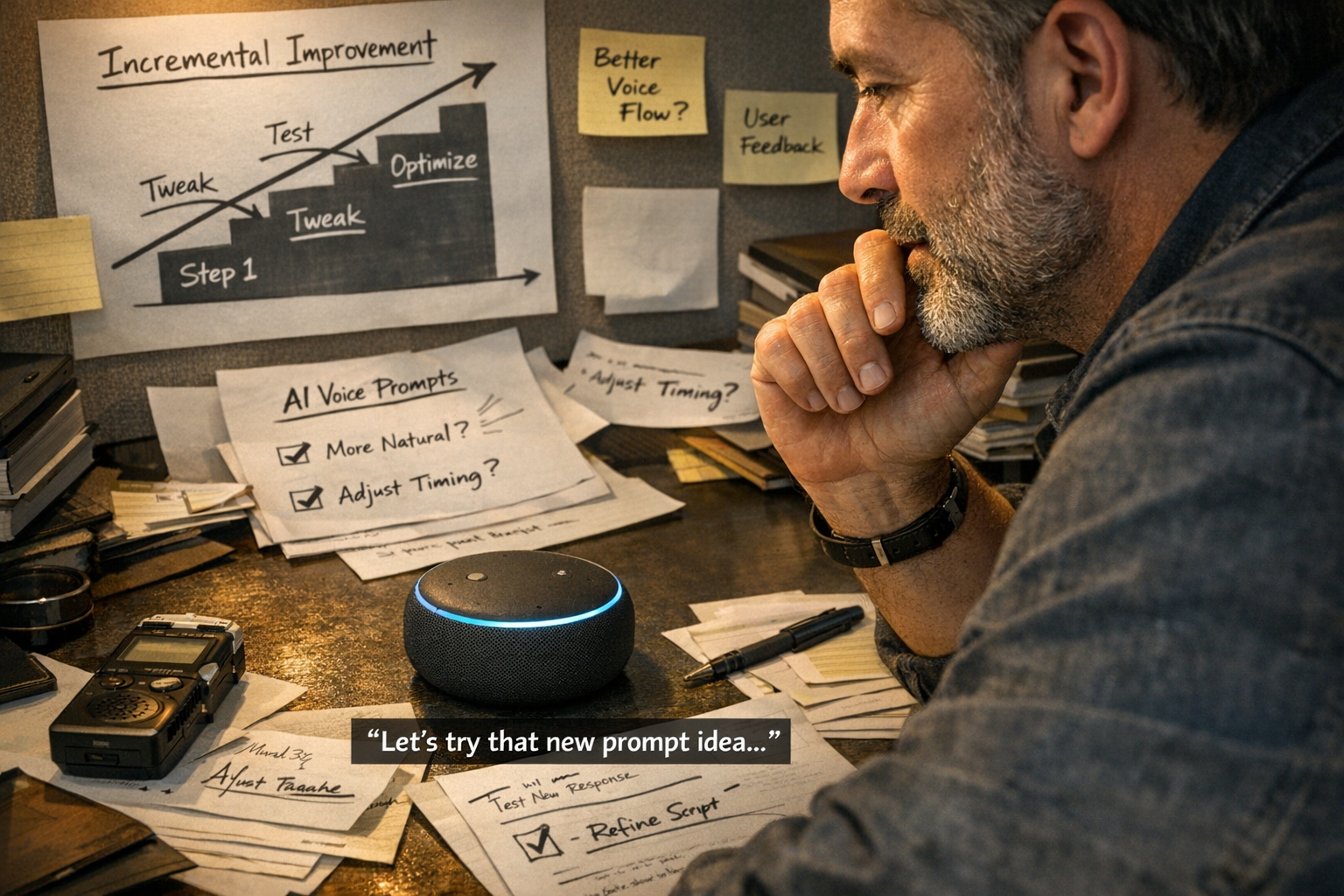
Small tweaks almost always beat dramatic rewrites. Adjust one thing. See what changes. Adjust again. It’s less glamorous than “start from scratch”, but it works because you can see what’s actually making the difference.
Here are the situations worth noticing when you’re deciding whether to adjust:
- You’ve launched a new offer and the tone feels mismatched to your audience
- You’ve had feedback that your content sounds generic or impersonal
- Your brand voice has shifted and your old prompt predates that change
- You’re using AI across a new channel with different expectations
- Outputs consistently need heavy editing before you’d publish them
Optimising voice prompts for AI isn’t about building the perfect setup and guarding it forever. It’s about being honest when the output drifts from what you’d actually say. I think of it less as maintenance and more as calibration. Little course corrections. Nothing dramatic.
So before you move on, read a recent AI-generated piece back properly. Not quickly. Properly. And ask yourself: does this genuinely sound like me?
That question alone will usually tell you whether adjusting your AI voice for better results is overdue.
The Case for Iterative Testing
If you’ve been asking yourself how often should I update my AI voice prompt, you’re already on the right track. The honest answer? Not on a fixed schedule. Not “every month”. Update it based on what you’re actually seeing. Iterative testing — small, deliberate tweaks followed by proper observation — almost always beats any arbitrary rule you’ve pulled from a blog post.
Why Small, Ongoing Refinements Beat Big Overhauls
Research from teams including Google Research and Chanl points in the same direction: continuous refinement improves AI voice performance more reliably than tearing everything up and starting again every few months. Which makes sense. When you make small adjustments, you’re reacting to real feedback, not guessing. Each change teaches you something specific about how your prompt is actually landing.
Optimising voice prompts for AI works best when you treat it like a conversation, not a one-off setup task you tick off and forget. You test one variable. You watch what shifts. Then you adjust again. That’s it. It’s not glamorous. It is effective.
And I think this is where a lot of people overcomplicate it. They assume improvement means reinvention. It usually doesn’t. It’s often quieter than that — one sentence clarified, one instruction repositioned, one scenario stress-tested properly instead of assumed.
Here are the core practices worth building into your process:
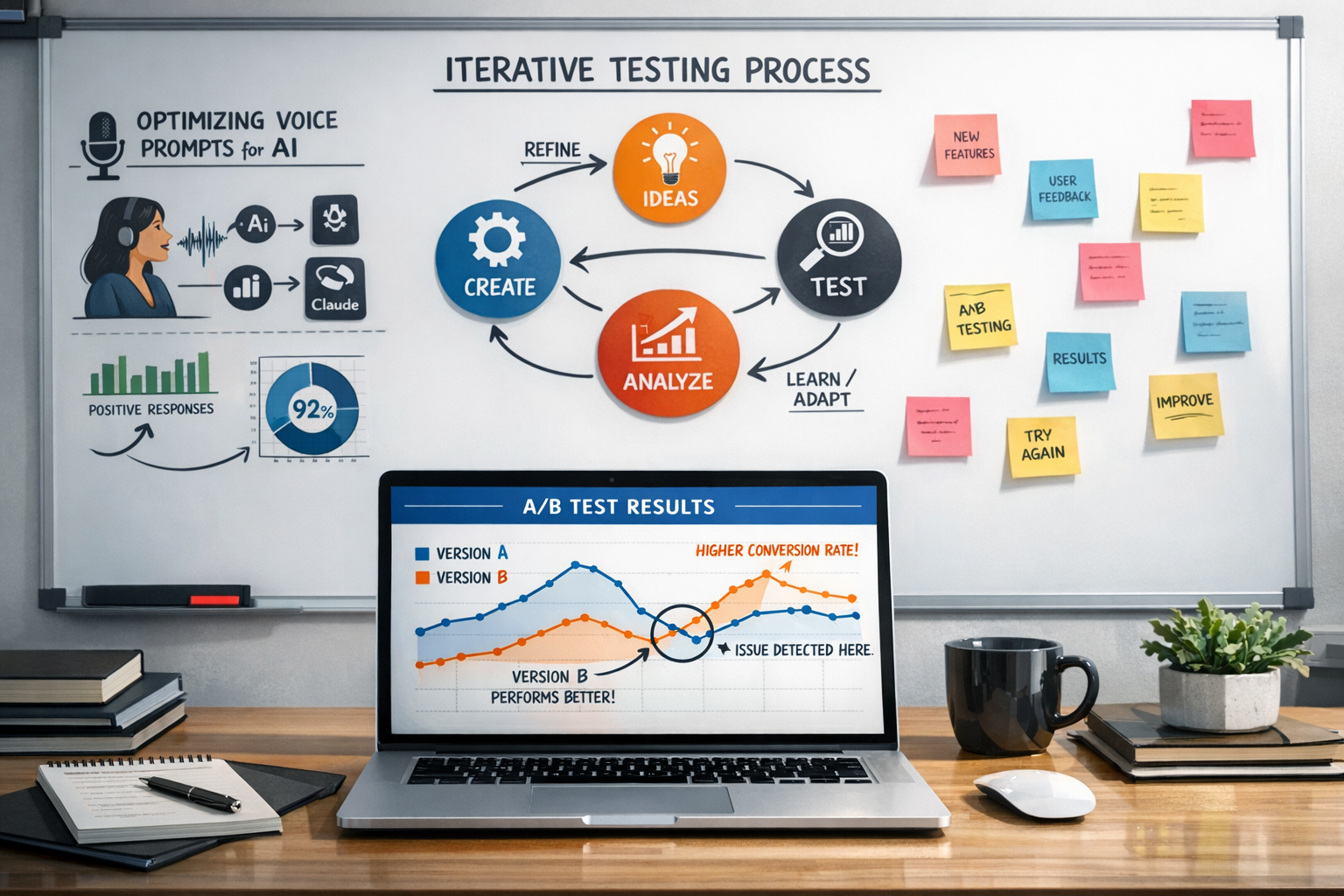
- A/B testing — run two versions of a prompt at the same time and compare how each performs against a clear metric (call completion, escalation rate, user satisfaction)
- Prompt repetition — repeat key instructions in different parts of the prompt to see which placement produces more consistent results
- Scenario orchestration — test your prompt against a range of likely user inputs, not just the ideal case
For the actual testing environment, I’d suggest Claude for prompt experimentation — it handles nuanced instruction well and makes it easier to isolate what’s working and what isn’t. When you’re ready to test in a live voice context, Retell gives you feedback loops that show how real conversations are playing out. That’s the point where adjusting AI voice for better results stops being theoretical and starts being practical.
The mistake I see most often? Waiting until something is clearly broken before revisiting the prompt. By then, you’ve already lost conversations you didn’t need to lose. Start small. Pick one scenario. Tweak one element. See what moves. Do that consistently and you’ll improve your AI voice prompts without turning it into a six-week “project”.
Harness the Power of Real-World Feedback
If you’ve ever wondered how often should I update my AI voice prompt, here’s the honest answer: it’s less about dates, more about signals. A diary reminder won’t tell you when something’s off. Your actual conversations will. That’s the bit people skip.
Watch What Your Conversations Are Telling You
Real-world monitoring really just means paying attention when things go slightly sideways. When your AI misreads a frustrated customer and responds like everything’s fine. When it escalates to a human… for no real reason. Those moments matter far more than a neat quarterly review.
Sentiment analysis is useful here, properly useful. If customers keep rephrasing the same question, sounding confused, or dropping off earlier than you’d expect, something’s not landing. That doesn’t automatically mean your prompt is “wrong”. It probably means it no longer fits the situations it’s walking into. And that’s normal. Things shift.
Post-call surveys are underrated, honestly. A simple “did we help you today?” can reveal patterns you’d never spot scrolling transcripts. On their own, transcripts can look fine. It’s when you zoom out and look at whole conversation flows that you start to see the friction. And friction is what you’re actually trying to reduce.
How Braintrust Can Help You Evaluate More Clearly
One tool worth knowing in this space is Braintrust. It’s built for evaluating AI conversation quality — not just highlighting obvious errors, but helping you see how the whole exchange lands. That broader view matters when you’re deciding whether adjusting your AI voice for better results is a small tweak… or something bigger.
The point of any evaluation tool isn’t to add complexity. It’s to move from gut reaction to grounded decisions. I see business owners change prompts after one awkward interaction, when actually the real issue is a pattern they haven’t clocked yet. Braintrust helps surface those patterns so you’re not just guessing.
A lot of updating AI voice prompt tips focus on what to change. But knowing when to change it is just as important, maybe more. Build the habit of reviewing real conversations regularly, not just when something breaks. That’s how optimizing voice prompts for AI becomes steady, intentional work instead of a panic fix.
Start small. Pick one conversation type each week. Look at what’s working. Notice what isn’t. Let that shape your next refinement. It doesn’t need to be complicated. It just needs to happen consistently.

Identifying and Addressing Common Prompt Failures
If you’ve ever wondered how often you should update your AI voice prompt, the honest answer is: whenever it stops sounding like you. That’s not a clever line — it’s the only measure that really matters. Most business owners wait until something has clearly gone wrong. By then? The tone’s been off for weeks and customers have already felt it.
The Most Common Failure Modes Worth Watching
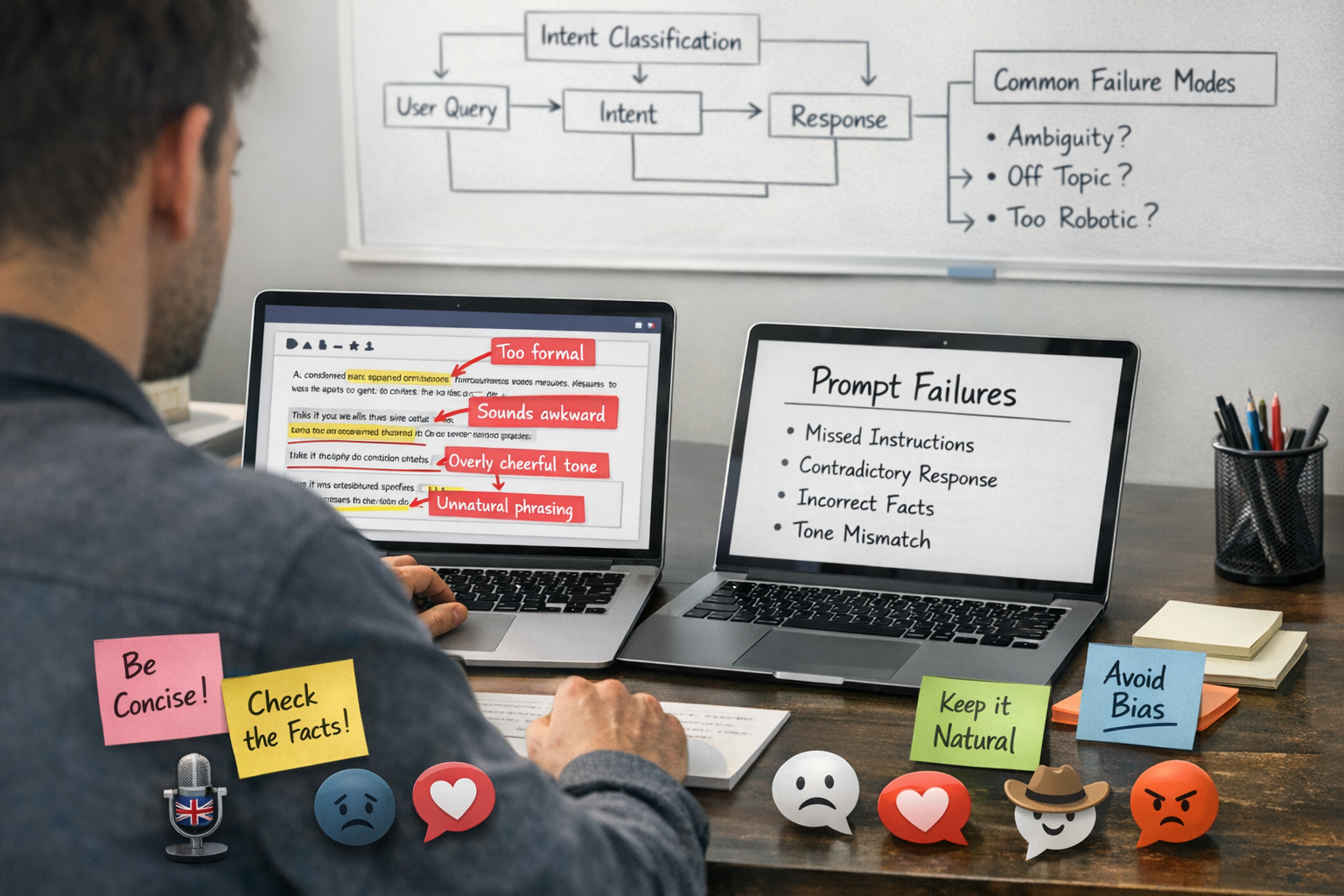
The biggest red flag is a tone mismatch. Your AI sounds chirpy when someone’s annoyed. Or stiff and formal when all they want is a quick, human reply. That’s not just a “tech hiccup”. It’s an intent classification issue — the AI is misreading the room. And if it’s misreading the room, it’s misrepresenting you.
Then there’s unnatural phrasing. This one’s subtle. Sentences that technically answer the question but feel… off. Slightly clunky. A bit robotic. Maybe too tidy. Trust slips here, quietly. When to change your AI voice prompt? Often it’s the moment you read a reply and think, “I wouldn’t say it like that.” Even if it’s correct. Especially if it’s correct but cold.
Why Diverse Scenario Testing Changes Everything
I think this is where many business owners drop the ball. They test their prompt in safe, straightforward scenarios. Calm enquiry. Simple question. Easy win. But real customers aren’t always calm or straightforward. Add frustration, urgency, or a strong regional accent and suddenly the whole thing wobbles.
A tool like VoiceInfra helps because it forces that kind of testing. You can run your prompt through different scenarios instead of assuming it’ll cope. And that’s the point — you’re not optimising for the easy cases. You’re pressure-testing the edges.
Adjusting your AI voice for better results isn’t about endlessly tweaking words. It’s about deliberately exploring where it breaks. Where it sounds sure of itself but slightly wrong. Or helpful but oddly detached. Those moments are your actual prompt refinement triggers.
The most practical thing you can do? Start a simple document. Notes app. Spreadsheet. Whatever. Log the replies that don’t sound like you. The ones that make you pause. Updating AI voice prompt tips only work when they’re based on real examples, not vague feelings. Over time, that running list becomes the clearest guide you have for how to improve your AI voice prompt — steadily, deliberately, without guessing.
The Importance of Maintaining Humanness
If you’ve ever caught yourself wondering how often should I update my AI voice prompt, the honest answer is: more often than you think. Not because you’re chasing perfection. But because things shift. You shift. And the whole point is making sure your AI still sounds like you.
What “Humanness” Actually Means in Practice
AI humanness isn’t about fooling anyone. It’s not smoke and mirrors. It’s about creating interactions that feel natural, consistent, and genuinely helpful — instead of stiff, robotic, or weirdly evasive.
I see this a lot: someone sets up their prompt, it sounds great at first, and then over time it drifts. The tone gets colder. More generic. It starts answering in ways that technically make sense but don’t actually sound like anything they’d ever say.
Adjusting AI voice for better results doesn’t mean tearing it all down and starting again every few months. It’s usually smaller than that. A phrase that felt right half a year ago but now feels slightly off. A tone that was formal because you were playing it safe — and now you’re not. These little shifts matter. They’re what keep your AI sounding like a real person behind a real business, not a slightly polished chatbot template.
The Balance Between Consistency and Natural Evolution
There’s solid logic behind prioritising humanness in AI interactions. Customer service research is pretty clear on this: people are happiest when their issue gets resolved properly, first time. That only happens when the response actually matches the question — in both content and tone. If your prompt hasn’t been looked at in months, it’s often the quiet culprit when things start feeling off.
Anthropic Claude is worth mentioning here because it’s genuinely useful for pressure-testing this. You can feed in your existing prompt and ask it to show you where the tone drops, where it sounds canned, where it stops feeling like a person. It won’t magically fix your thinking. But it does make it much easier to spot what’s not quite landing.
Optimising voice prompts for AI isn’t a one-and-done task. Your business evolves. Your customers’ expectations change. The language that felt strong last year might feel slightly clunky now — and sometimes you can’t even put your finger on why, it just does. Treat your prompt like a living document, not a finished artefact, and you’ll spend far less time wondering why your AI isn’t working the way you expected.

Sources:
Google Research 2026