
Introduction
You create a freebie. You build the landing page. You share it a few times. Then it just sits there.
If that feels familiar, I doubt the problem is the content inside it. Most of the time, it is the name on the front.
Knowing how to name your freebie so people actually download it sounds simple. It is not complicated, but it quietly decides whether your lead magnet works or fades into the background. I see titles that describe the format or vaguely hint at a benefit. Neither is strong enough to make a busy person stop and hand over their email.
In this article, I break down why freebie titles underperform, how to write a name that earns the download, and how to make sure your freebie does more than just grow a list. I am not interested in complex strategy for the sake of it. This is about making the small decisions that move the needle.
Key Takeaways
- Naming your freebie after its format, such as “guide,” “checklist,” or “toolkit,” tells people what shape it is, not why it matters. I focus on naming the outcome, not the document. The format is secondary. The result is what earns attention.
- Specific titles outperform vague ones. When I clearly state what someone will be able to do, feel, or avoid after downloading, the rest of the page has less heavy lifting to do. Precision builds trust. General promises blend in.
- A deadline is one of the simplest ways I know to increase downloads. It does not require a huge audience or a complicated funnel. A short email sequence with a genuine end date gives people a reason to act now instead of bookmarking it for later and forgetting.
- Your freebie should connect directly to your paid offer. I treat it as the first step towards the bigger result I sell, not a standalone resource floating on its own. If there is no clear path forward, it often attracts the wrong people or stalls completely.
- Checklists, templates, and audits are consistently strong formats when they are named well. I make sure the title reflects the specific task that becomes easier or the specific problem that gets resolved. Not just the fact that a resource exists, but why it is useful right now.
The article below walks through each of these points in more detail, with examples to keep the decisions practical and grounded. I am aiming for clarity over cleverness, because in my experience that is what actually gets the download.
The Problem with Typical Freebie Names
If you actually want people to download your freebie, we need to talk about the graveyard of lead magnets quietly sitting on landing pages with titles that say… nothing. Or at least nothing useful.
They’re there. They exist. But they’re barely being touched.
And most of the time, it’s not because the content is bad. It’s because the name does absolutely none of the heavy lifting.
Saying What It Is Isn’t Enough
The most common mistake I see? Naming the freebie after the format instead of the outcome.
“Free guide.” “Starter kit.” “Checklist.”
That tells me what shape it is. Not why I should care.
No one wakes up desperate for a PDF. They wake up thinking about their problem. The stress. The time they’re wasting. The thing they don’t understand yet. File types are irrelevant.
Creating compelling lead magnet names is really about closing the gap between what you’ve made and what your reader actually wants. “Content Planner” sounds tidy. Fine. But it’s vague. It’s asking me to assume it’ll help.
“Plan a Month of Content in 90 Minutes”? That’s doing the work your entire landing page has been trying to do. It’s specific. It names the payoff. It earns attention.
Here’s the honest truth about how to choose a title for a freebie: specificity converts. Vagueness doesn’t. The clearer you are about the outcome for an actual person with an actual problem, the less you have to compensate with aggressive ads or a massive audience.
Without that clarity, you’re basically saying, “Trust me, it’s good.” And most people won’t. Not because they’re difficult. Because they’re busy.
There are a few patterns that almost always underperform when it comes to effective freebie titles:
- Format-led names (“The Workbook,” “The Template Pack”)
- Benefit-free adjectives (“The Ultimate Guide,” “The Complete Toolkit”)
- Vague transformation claims (“Level Up Your Business”)
- Industry jargon that means nothing to a new reader
None of these are evil. They’re just empty.
Good lead magnet naming strategies start with one simple question: what will someone be able to do, feel, or avoid after using this?
If your title doesn’t answer that, even roughly, it’s quietly working against you before anyone clicks. And that’s the part people often miss.
Make the Title Do the Work
If you want people to actually download your freebie, start here: the title isn’t decoration. It’s not a cute extra. It’s the whole hook. It’s the line that makes someone stop mid-scroll and think, “Yes. I need that.”
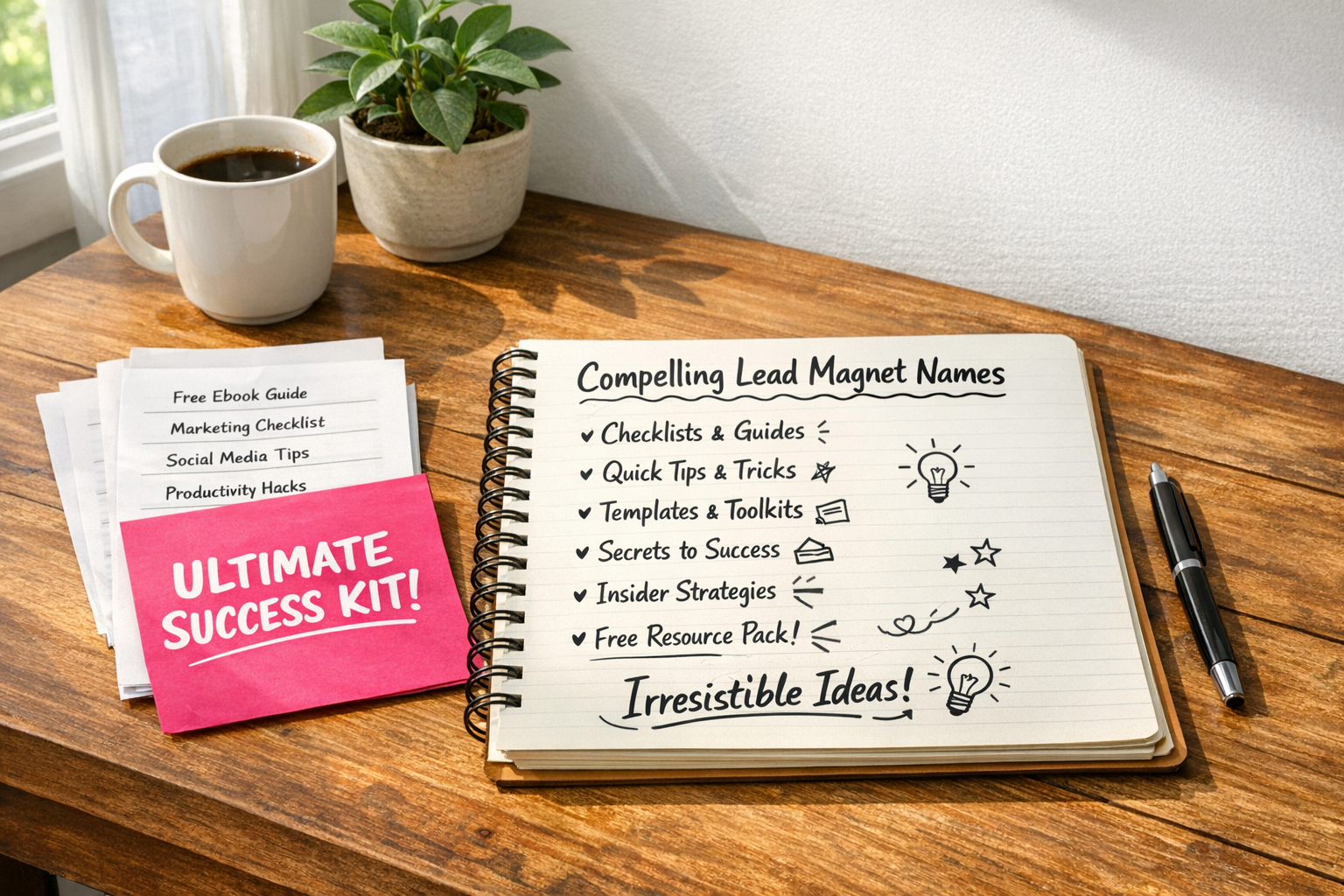
Most freebie titles flop before the content even gets a look in. They’re vague. They’re trying to be clever. Or — and this is the one I see all the time — they describe what the thing is instead of what it does. “My Marketing Toolkit” means nothing to me. “Facebook Profile Audit” tells me exactly what I’m getting and why I should care.
Effective Freebie Titles Sell the Outcome, Not the Format
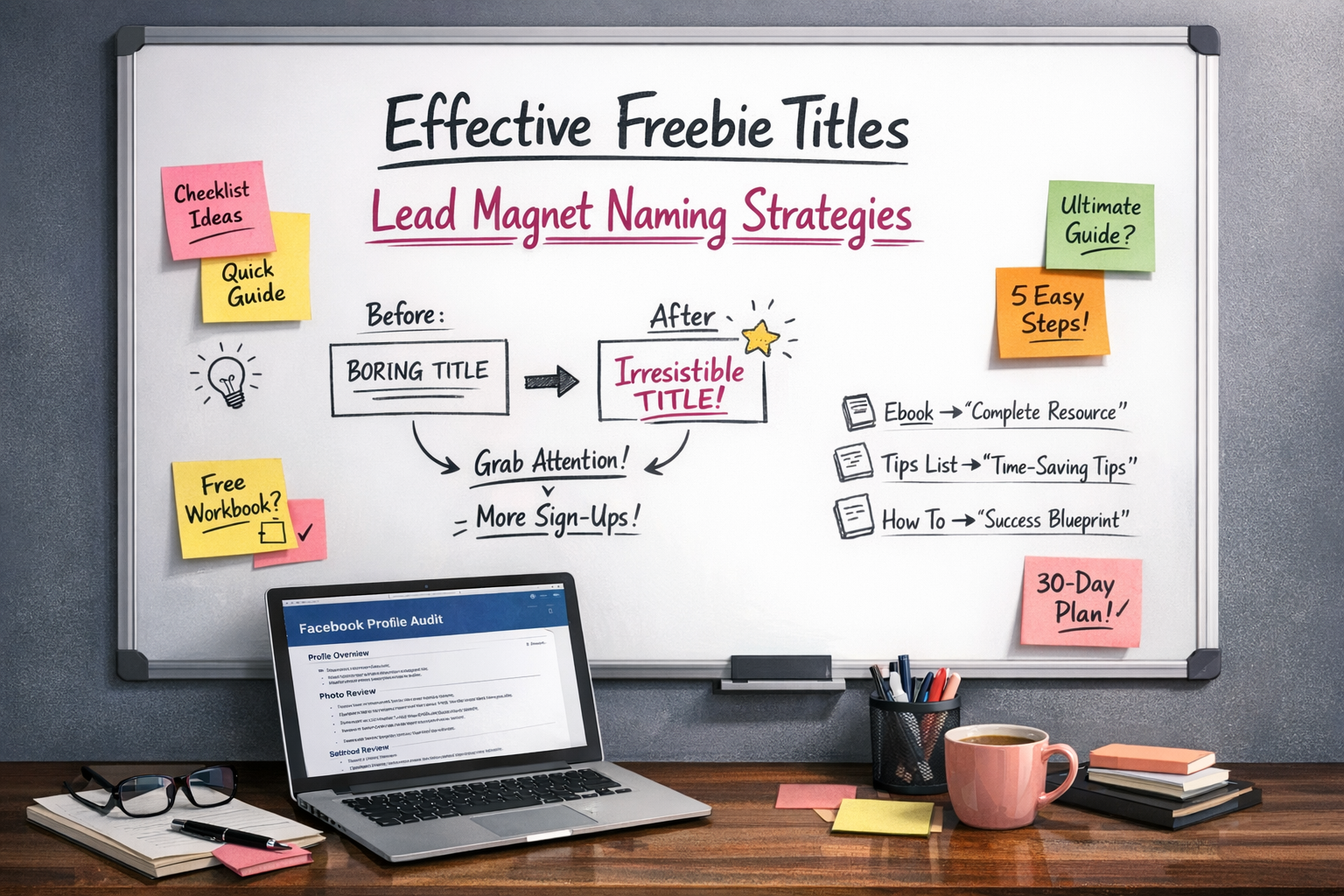
Your title needs to sell the outcome, not the document. There’s a big difference between “Social Media Guide” and “5 Things to Fix on Your Instagram Profile Today.” One sounds like homework. The other sounds like progress.
Lead magnet names that work usually follow one simple rule: specific beats vague. Every time. When you promise a clear, achievable result, people can picture the benefit before they’ve even clicked. That moment of, “Oh. That’s my problem,” is what gets the download.
And I think this is where people overcomplicate it. They start worrying about sounding impressive instead of sounding useful. But your reader isn’t looking for impressive. They’re looking for relief. For clarity. For something that fixes the thing that’s currently annoying them.
So think about the one thing they’re trying to fix, avoid, or achieve right now. Reflect that straight back to them in plain English. No jargon. No fluff. No dressing it up to sound smarter than it needs to be.
When you’re figuring out how to choose a title for a freebie, ask yourself one blunt question: if someone only saw this title, with zero context, would they instantly know what problem it solves? If not, rewrite it. Compelling lead magnet names aren’t about being clever. They’re about being clear enough that the right person feels immediately seen.
The best lead magnet names almost feel obvious afterwards. Like of course that’s what it’s called. They don’t try to do everything. They pick one outcome, state it plainly, and let that simplicity do the heavy lifting.
Creating Urgency with Limited-Time Availability
Once you’ve worked out how to name your freebie so people actually download it, the next question is obvious: how do you get them to act now instead of “I’ll do it later”?
One of the simplest, most underused tactics is this — tell them it’s coming down in a few days.
That’s it. No drama. No seven-layer funnel. Just a real deadline.
Why a Limited-Time Freebie Gets More Downloads
Scarcity works because it moves your freebie from “nice idea” to “oh — I might miss this.” And that shift matters more than people think. You don’t need a massive audience for this to work. Even a small, engaged list will respond when there’s a proper end date.
This isn’t manipulation. I think that’s where people get twitchy. It’s not about fake countdowns or nonsense urgency. It’s just giving people a reason to stop procrastinating. We all do it. We all mean to download things “at some point”. A deadline cuts through that.
Honestly, this is one of the more effective urgency tactics precisely because it’s straightforward. You’re not pretending something is rare when it isn’t. You’re deciding it’s coming down — and saying so.
And it’s interesting how often a simple “this disappears on Friday” email pulls in more downloads than weeks of quietly linking to it in your footer or posting about it once on Instagram and hoping for the best.
The key is following through. If you say it’s going down and it doesn’t, people clock that. Maybe not consciously, but they do. And you’ve just trained them that your deadlines don’t mean anything.
A simple limited-time email sequence works well here, and you can automate the whole thing inside AWeber without turning it into a technical circus:
- An announcement email explaining what the freebie is and when it’s going down
- A reminder email one day before the deadline
- A final “last chance” email on the day itself
That’s it. Three emails. A real end date. A freebie with a clear, compelling title.
You don’t need funnels inside funnels or advanced automation logic. Just one sequence that delivers the download immediately, then schedules those three emails to go out automatically. Set it up once. Leave it alone. Let it do its job in the background.
Lead magnet naming strategies and effective freebie titles matter enormously here, because urgency only works if people actually want the thing. A weak name with a deadline still won’t convert. A strong name with a deadline — delivered cleanly and followed up properly — almost always will.
Align Your Freebie with Paid Products for Seamless Conversions
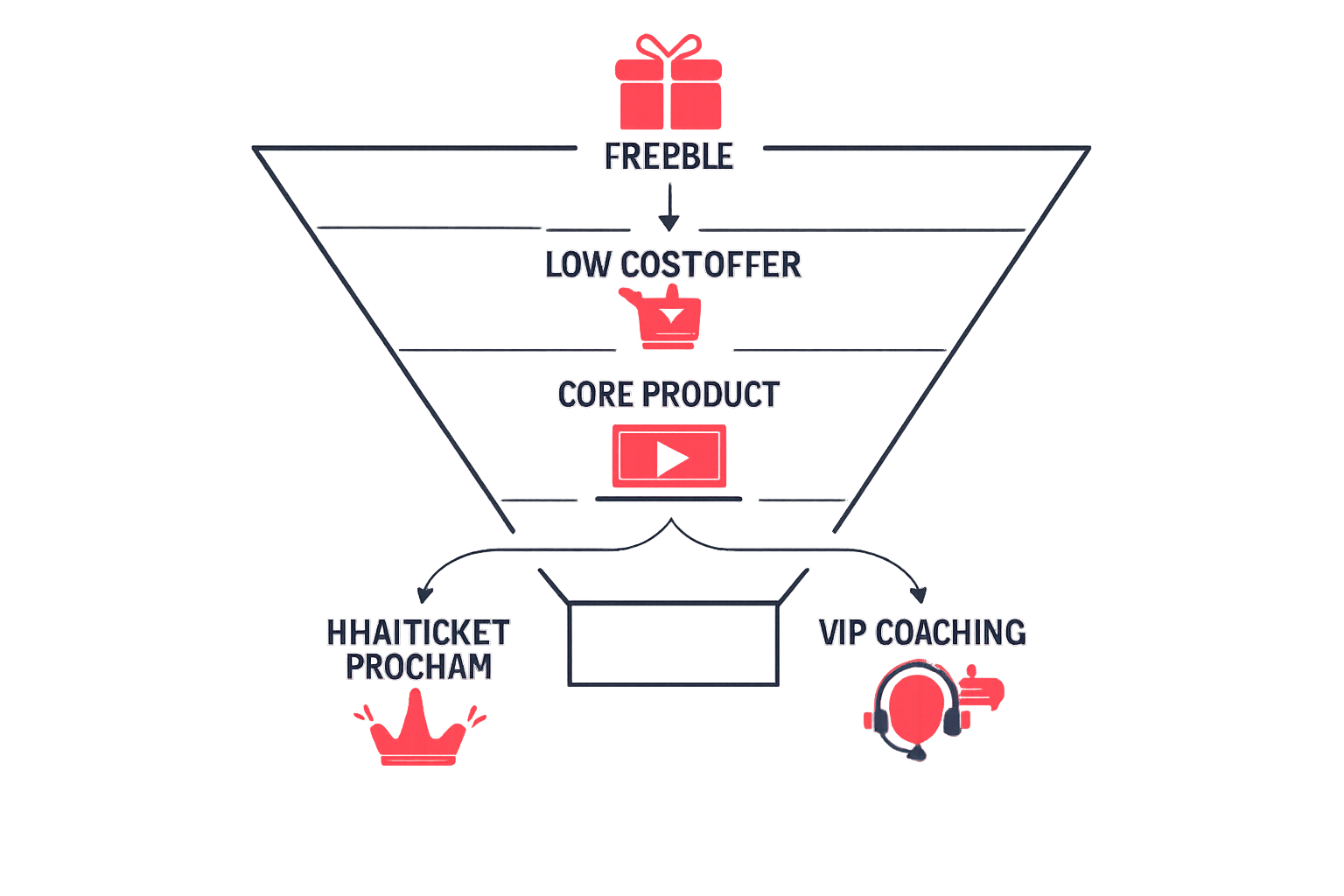
When you name your freebie so people actually download it, you’re not just fixing a title. You’re deciding where that freebie is heading. A well‑named lead magnet doesn’t just attract clicks. It signals the kind of transformation you’re known for and quietly points towards paying for more of it.
Your Freebie Is a Sales Funnel Breadcrumb, Not a Business Card
A lot of business owners treat their freebie like a nice gesture. Pop it out there, grow the list, hope something happens. But the most effective freebies don’t sit alone. They act like a breadcrumb. They solve one specific, immediate problem and, in doing that, make the bigger issue obvious — the one your paid offer is actually built to handle. That gap? That’s where conversion lives.
Look at what your paid product truly delivers. Not the features. The actual outcome. Then work backwards. What’s the single first step someone needs before they’re ready for that? That’s your freebie. And the title should name that step plainly.
When you’re thinking about lead magnet naming strategies, this isn’t about being clever. Or cramming everything in. It’s about creating enough momentum that your ideal client thinks, “If the free thing is this useful, the paid thing must be even better.” That premium client attractor effect starts with alignment. Not volume. Not noise.
Creating compelling lead magnet names often means holding yourself back a bit. There’s a temptation to make the freebie sound like the full solution. I get it. But if it solves everything, there’s no reason to take the next step. Leave space for your paid offer to exist. It’s allowed to be incomplete.
When you’re choosing a title for a freebie, ask yourself — honestly — does this result lead into my paid offer, or does it accidentally compete with it? The best names for lead magnets promise a genuine quick win. Something useful. Tangible. And at the same time, they make it obvious there’s more depth available when someone’s ready.
If your freebie and your paid offer feel loosely connected — or worse, totally unrelated — your conversion path will feel messy. Confusing. It doesn’t matter how polished your email sequence is. Tighten the alignment first. Then worry about the title.
Examples of Top Performing Freebie Types with Strong Titles
If you want to name your freebie so people actually download it, the format matters just as much as the words. Certain types of lead magnets convert well again and again — not because they’re clever or creative, but because they’re instantly useful. That’s it. Here’s what I see working, and why the title either carries it… or quietly kills it.
The Three Freebie Formats Worth Your Time
The formats that tend to perform best solve one specific problem, quickly. Not five problems. Not “everything you need to know”. Just one. That’s why checklists, templates, and audits consistently do the job. When they’re named properly, they’re some of the strongest freebie titles out there. Each format signals a different type of value, and the title has to reflect what someone is actually getting — not what you hope they’ll assume.
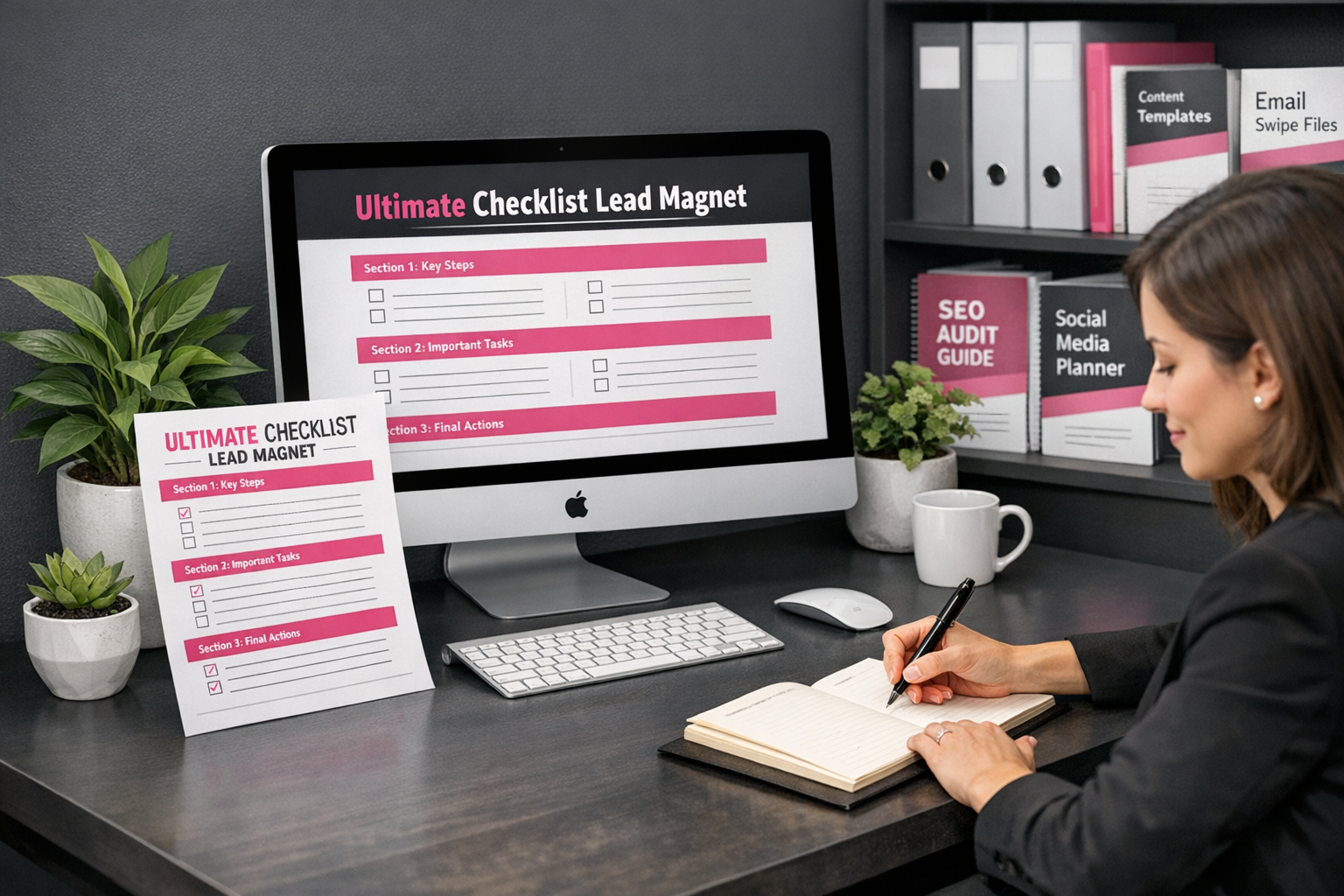
A checklist works because it removes mental load. It says, “You don’t have to think about this — I’ve done it.” The best checklist titles are outcome-led. Something like “The Pre-Launch Checklist: 10 Things to Do Before You Go Live” makes it obvious what changes once it’s completed. Compare that to “Marketing Checklist”. Fine. But why would I hand over my email for that? It’s too broad. Too vague. No urgency.
Templates work because they do part of the work for you. That’s the appeal. A printable or editable resource called “The Weekly Content Planner Template for Busy Service Businesses” is clear and specific. “Content Template” isn’t. When you’re naming a template, reference the task that becomes easier — not just the fact it’s a template. The format alone isn’t the selling point. The saved time is.
Audits convert because they create a small jolt of awareness. A title like “Is Your Website Losing You Clients? A 5-Point Audit” uses a question to surface a doubt that’s probably already there. It doesn’t scream. It nudges. I think that’s why they work so well — people often suspect something’s off, they just haven’t stopped to check. When you’re naming an audit, lean into the problem they’re already circling.
Once the format and title are sorted, the next question is simply: how are you delivering it? Keep it simple. Hosting the file somewhere like Google Drive works perfectly well. It’s free, reliable, and no one needs a tutorial to open it. For delivery — and to run that short deadline sequence in the background — a straightforward email platform like AWeber handles the automation without turning into a tech project. You upload the file, set up the confirmation email, add your three follow‑ups, and you’re done. The goal isn’t an impressive system. It’s clean, frictionless access.
A few title patterns worth borrowing:
- Checklists: “The [Specific Task] Checklist for [Audience/Situation]”
- Templates: “The [Task] Template: Done-for-You [Outcome]”
- Audits: “Is Your [Thing] Doing [Problem]? Find Out in [Timeframe]”
How to choose a title for a freebie isn’t really about creativity. It’s about clarity. If someone can’t immediately tell what they’ll have — or what they’ll understand differently — after downloading, the title needs another look. Effective freebie titles aren’t flashy. They’re honest about the result. And honestly, that’s usually more than enough.
Sources:
“The Wanderlover” (2024)