

Do I Need a Sales Page for a Free PDF?
I see a lot of people building what looks like a full marketing campaign just to give something away for free. It gets heavy, fast. And most of the time, it is not needed.
The question of whether you need a sales page for a free PDF trips people up. You are already busy. You do not want to build the wrong thing, or overbuild something simple.
Here is what actually matters. I will break down what a freebie funnel needs, why a full sales page is usually the wrong move, and what to build instead. I will cover the difference between a sales page and a lead capture page, why low friction beats impressive copy, and how to set this up in a way you will actually launch.
A free PDF is a low-stakes ask. No one is handing over money. No one is making a big commitment. Your setup should reflect that. Keep it proportionate.
Key Takeaways
- A sales page for a free PDF is more than you need. You are not overcoming price objections or helping someone justify a big decision. A short lead capture page that explains what the PDF is and who it is for is enough.
- A simple three-step flow is all that is required: a landing page, a thank you page, and a welcome email that delivers the PDF. Anything beyond that is optional. It might be useful later, but it is not essential.
- Low friction increases sign-ups. Extra form fields, long copy, and fake urgency create hesitation. At this stage, clarity and ease do more work than persuasion.
- Urgency is worth considering, but it needs to be real. You can frame a free resource as available for a limited time if that is true. If there is no real deadline, I would not pretend there is one. People can feel that.
- The tool matters less than keeping the process contained. Whatever platform you use, I look for one that handles the landing page, form, and automated delivery in one place, with as few moving parts as possible.
If you have been putting off launching a free PDF because the setup feels complicated, keep reading. The bar is lower than you think. Often much lower.
Ditch the Sales Page: Simplify Your Free PDF Funnel
If you’ve been agonising over whether you need a full-blown sales page for a free PDF, let me save you the spiral: you don’t. No one’s taking out their card. There’s no price objection to wrestle with. No big persuasion job required.
You just need a simple page that says what it is, who it’s for, and makes it stupidly easy to say yes.
Sales Pages vs. Landing Pages: What’s the Actual Difference?
A sales page turns a sceptical reader into a paying customer. It handles doubt. It builds desire. It does the heavy lifting.
A lead capture page — which is what you actually need for a freebie — answers one much smaller question:
“Is this worth my email address?”
That’s it. The bar is lower. So your approach should be simpler. I think this is where people overcomplicate it. They build for a sale when all they need is a nod.
The simplified funnel strategy for freebies that actually works looks like this:
- A short landing page that clearly states what the PDF is and who it’s for
- A thank you page that confirms what happens next and optionally offers a next step
- A welcome email that delivers the PDF and starts building the relationship
That’s it. Three steps. No bloat. No marketing gymnastics.
Why Low Friction Is Your Best Friend Here
The importance of urgency in free downloads is often overstated. People don’t need to be pushed into taking something that costs them nothing. They’re not standing there debating a £2k investment.
What they need is clarity. And ease.
Every extra form field. Every rambling paragraph. Every dramatic “but wait, there’s more” moment. It often feels like friction for the sake of looking impressive. And friction kills sign‑ups.
A lot of business owners overbuild this because they’ve been told more content equals more trust. In a freebie context, I’m not convinced that’s true. Short, clear and confident usually beats long and overwrought. Almost every time.
If you’re wondering how to create a funnel for free PDFs without building a tech monster, the simplest approach is usually to build it inside the system you already rely on. For some, that’s an email-first platform. For others, it’s a CRM. If you’re already running your contacts and automations through something like GoHighLevel, you can create the landing page, form, and automated welcome email right there and keep everything under one roof. No extra connectors. No duplicated lists. No patchwork stack.
The tool matters far less than keeping the process simple. What you’re looking for is friction reduction — fewer moving parts, fewer decisions mid-build, fewer places for something to break.
When you’re ready to launch your next PDF, resist the urge to make it clever. Or bigger. Or more impressive.
Build the three-step flow. Strip out anything that creates hesitation. Let the freebie do the job it was built to do — get the right people onto your list.

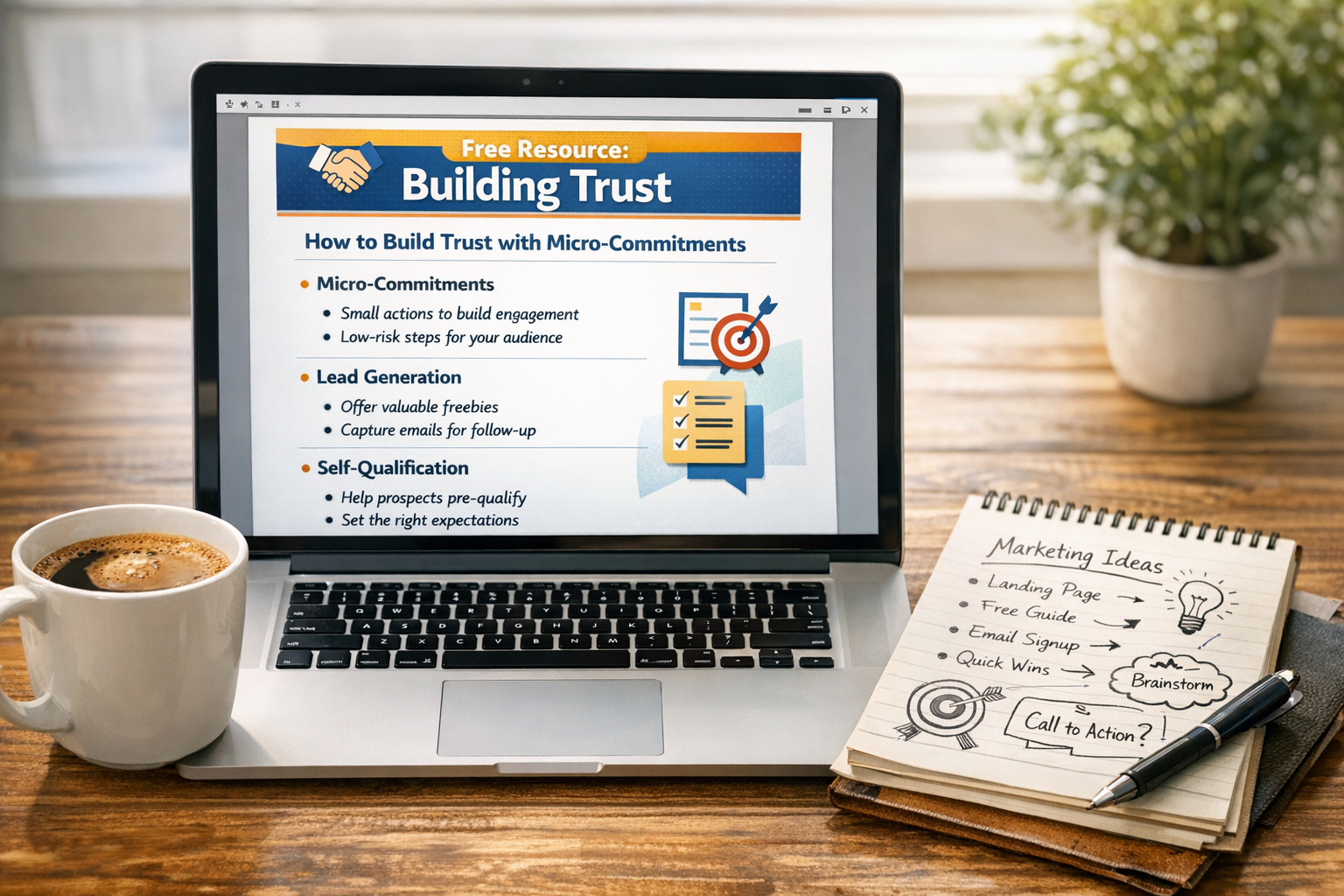
The Power of Micro-Commitments in Building Trust
If you’ve ever caught yourself wondering whether you need a full-blown sales page for a free PDF, you’re not the only one. And honestly, the answer matters more than people think. A free PDF isn’t just a nice little giveaway. It’s the first small step someone takes towards you — and that step carries weight.
Why a Small Ask Can Do a Big Job
A micro-commitment is exactly what it says on the tin: a tiny, low-stakes action that gets someone moving. Asking for an email address in exchange for something genuinely useful is about as low-friction as it gets. No payment. No essay-length form. No dramatic decision. Just: “Yes, I want this.”
That’s why it works.
When someone downloads your free PDF, they’re not just grabbing a file. They’re quietly telling you what they care about. What problem’s nudging at them. Whether your way of explaining things clicks. That’s self-qualification happening in real time, and it does more for your future marketing than any clever bit of tech ever will.
I think this is where people overcomplicate their funnel strategy for freebies. They obsess over pages and platforms and wording tweaks. But you’re not “just building a list”. You’re building a list of people who have actively raised their hand for something specific. That’s a different starting line entirely. Warmer. Clearer. Easier to work with.
The minimal ask — email only — matters more than most admit. The second you start adding extra fields, the energy shifts. It often feels small, but sign-up rates drop when the form gets longer or the exchange feels uneven. Keep it clean. Keep it simple. Let the resource carry the weight.
And this is why the whole debate about whether free PDFs need sales pages sometimes misses the mark. The point isn’t to sell. It’s to open a door. To create a small moment of connection that earns you the right to keep talking. You don’t need urgency tricks or a three-scroll pitch for that.
If you haven’t got a free resource that asks for nothing more than an email, start there. One specific question your ideal reader is already typing into Google. Answer it properly. Short. Useful. Done.
That one micro-commitment? It might quietly be the most valuable part of your entire funnel.
Creating Urgency Without a Sales Page
You don’t need a full-blown sales page for a free PDF to make people want it. You do, however, need to give them a reason to act now rather than “at some point”. That’s where urgency comes in.
Why Urgency Still Matters for Free Offers
It’s easy to think urgency is only for paid offers. I don’t know why we do that, but we do. And it quietly costs you downloads. The importance of urgency in free downloads is real: when something feels endlessly available, it feels optional. People think, “I’ll grab that later,” bookmark it, and then… nothing.
A time-limited framing shifts that without extra tech or a complicated funnel. Simple phrases like “available for the next 3 days only” or “this resource comes down on Friday” give someone a proper reason to act today. You don’t need a countdown timer or some dramatic build-up. You just need clear language that says this isn’t permanent.
The important word there is clear — and honest. Fake urgency, where the deadline magically resets every time someone visits, erodes trust fast. If you say it’s available for 3 days, mean it. If it’s coming down on Friday, take it down. It’s not about pressure. It’s about clarity.
How to Apply This to Your Existing Free Resources
A lot of business owners have PDFs sitting on their website with absolutely no deadline-driven conversion element. The link is just… there. Hanging about. No context. No reason to move now. That’s a missed opportunity — and it’s honestly an easy fix.
Here’s how to add urgency without overcomplicating your simplified funnel strategy for freebies:
- Set a genuine window — a launch period, a seasonal tie-in, or a content refresh date
- State the deadline clearly on your landing page, in your email, and in any social posts promoting it
- After the window closes, retire the offer or replace it — this keeps future urgency credible
- Reopen it intentionally, as a new event, rather than leaving it live indefinitely
This works whether you’re asking do I need a landing page for a free PDF or figuring out how to create a funnel for free PDFs from scratch. Urgency isn’t a flashy feature you bolt on. It’s a decision. A positioning choice. It lives in your copy.
Go back to one free resource you’re promoting right now and ask: is there any real reason for someone to download this today? Not this month. Not eventually. Today.
If the answer’s no, that’s where you start.

Overcomplicating Less, Launching More
If you’ve ever spent three weeks building a sales page for a free PDF, you’re not alone — and you’re not ridiculous for trying. I get why it happens. We’re told every offer needs strategy, structure, layers. But here’s the truth: a free offer does not need the same sales architecture as a £500 course. Treating it like one is one of the easiest ways to delay putting something genuinely useful out into the world.
Why free PDFs don’t need sales pages crammed with testimonials, FAQs, countdown timers and the rest comes down to one simple thing: the friction should be close to zero. No one’s being asked for their card details. They’re handing over an email address. That’s a much smaller decision. Let’s not pretend it’s the same level of commitment.
The Simplified Funnel Strategy for Freebies That Actually Works
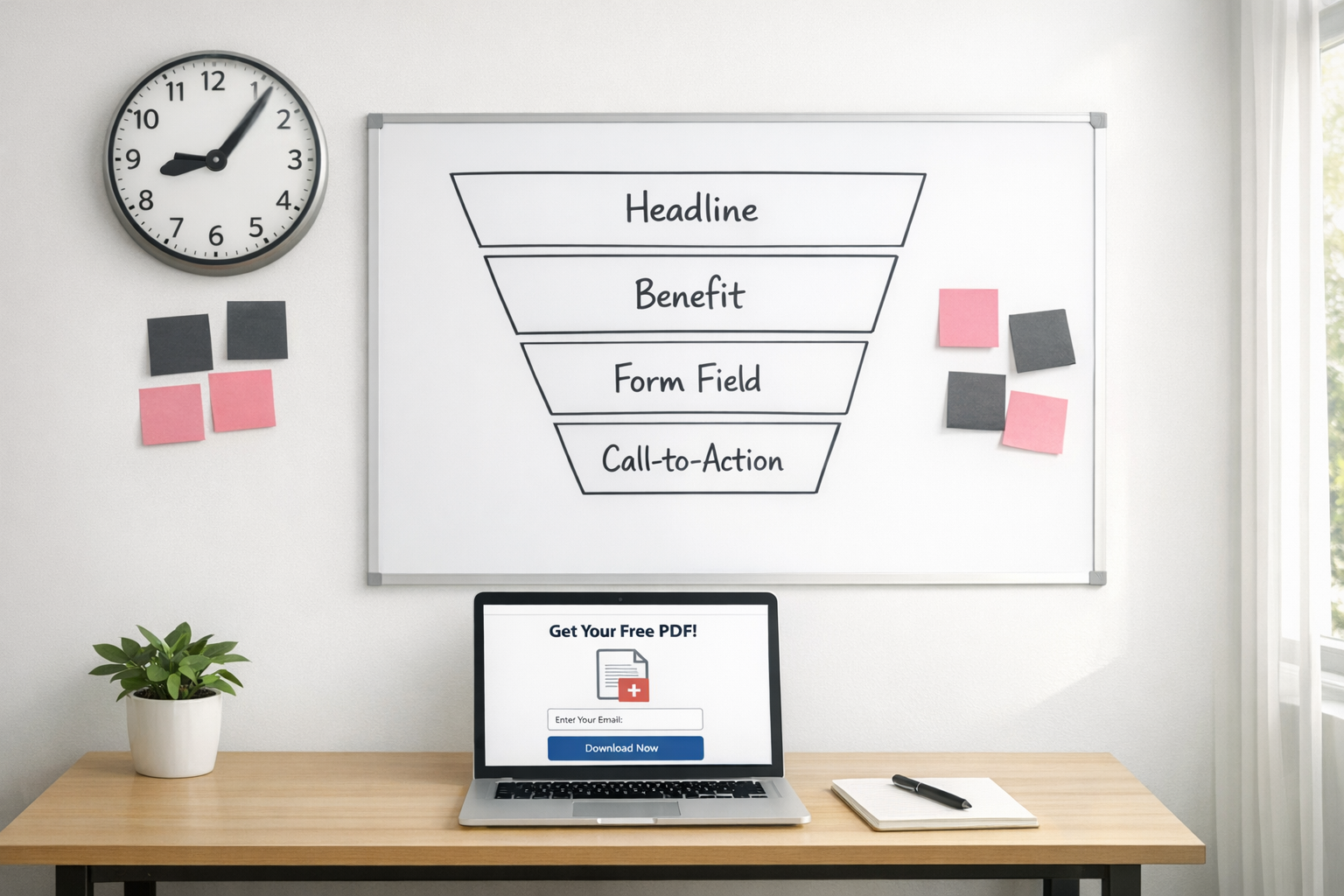
A simplified funnel strategy for freebies really only needs four things: a clear headline, one strong benefit, a form field, and a call-to-action. Done. Everything else is decoration. And that decoration costs you time. It also adds decision fatigue before you’ve even hit publish.
Decision fatigue is real. Not just for your audience — for you. The more complicated you think it has to be, the heavier it feels. The heavier it feels, the longer it sits in draft. And once it’s sitting in draft, it’s helping no one. I honestly think speed matters more than polish at the freebie stage. You can refine something that’s live. You can’t refine something you haven’t released.
And this is the bit people don’t always say: many business owners get completely respectable opt-in rates from a single, well-written page they built in an afternoon. Often inside the same platform that handles their emails or CRM — no separate stack required. If you’re already using something like GoHighLevel, that can be as simple as building the page and automation there and pressing publish. No bells. No clever layering. Just clarity. That isn’t settling. That’s good decision-making. A freebie is there to start a conversation. It’s not there to close a sale.
When you catch yourself wondering whether you should add more sections, more proof, more copy — pause. Ask a better question: would this actually stop someone downloading something free? If the honest answer is no, cut it. Get it live. Prioritise momentum over perfection. Your simplified funnel strategy for freebies should feel light enough to launch, not heavy enough to stall.
Best Platforms for Simple Lead Capture Funnels
If you’ve been wondering whether you need a full sales page for a free PDF, the short answer is: probably not. What you actually need is a clean, simple landing page that captures an email address and delivers the thing. That’s it.
The platform you use matters more than most people realise — not because of shiny features, but because the wrong tool adds friction you don’t need. And friction kills momentum. Fast.
Choosing a Landing Page Builder That Doesn’t Overcomplicate Things
When you’re figuring out how to create a funnel for free PDFs, it’s tempting to go hunting for the “most powerful” tool available. I get it. It feels responsible.
But it’s usually the wrong instinct.
What you actually want is something that handles form automation cleanly, sends a welcome email automatically, and then gets out of your way.
GoHighLevel suits a particular setup. If you’re already managing client relationships and want lightweight CRM functionality built in, it can run the whole three-step funnel without bolting on extra tools. Landing page. Thank you page. Automated delivery. All in one place. It does take more effort to set up than a basic email tool. But if you’re running multiple lead magnets or layered automations, keeping it under one roof often prevents the tech sprawl that slows everything down.
Simpler Setups Worth Considering
If you’re earlier stage, or you want your funnel to be strictly email-first, a straightforward email marketing platform can be enough. The key is not the brand name — it’s that the landing page and automation live together, with minimal configuration.
The platforms that work best for a simplified funnel strategy for freebies all tend to share one thing: they reduce decisions mid-build. And that’s what really matters. Because when you’re building, decision fatigue kicks in quickly. You start second-guessing. You tweak things that didn’t need tweaking.
Here’s what to look for:
- Built-in form automation that triggers delivery without manual steps
- A landing page builder that works without a developer
- Email integration that’s either native or one simple connection
- Minimal ongoing maintenance once it’s live
The importance of urgency in free downloads is often overstated. You don’t need fake countdown timers for a PDF. But removing delay? That matters.
If someone has to wait, click through three pages, confirm twice, check their inbox, then click again — you’ll lose a chunk of them. Not because they’re lazy. Because life interrupts.
You don’t need every feature. You need the ones that make the handoff — from “I want this” to “I have this” — feel instant and effortless.
Pick one tool that matches your stage. Map out the simplest version of your next PDF funnel. Build that first. Then stop.

Sources:
The Killer Sales Page Template (V2) (Scribd, Year)