


You’re making video content. Maybe it’s YouTube, TikTok, LinkedIn, or just internal training stuff. But your blog looks like a ghost town because you’re pretending you have time to write blog posts from scratch on top of everything else. You don’t. The fix isn’t harder work, it’s realising you already have the raw material sat there waiting to be turned into blog posts that actually drive traffic.
Repurposing video content isn’t lazy. It’s leverage. Your audience is fragmented across platforms anyway. Some people watch videos. Some people read. Most people do both depending on what they’re doing that day. Turn video content into blog posts and you’re not doubling your effort, you’re doubling your reach with the work you’ve already done.
This guide walks you through a repeatable system that doesn’t require you to be a blogging expert or hire someone full-time. We’ll cover the two-step AI approach that actually works, how to build a sustainable content engine, and the SEO basics that matter without letting them run your life.
TL;DR for the Impatient Nugget Seekers
- You already have the content. Your video is the hard part. Converting it to blog posts is the easy win you’re skipping.
- Use a two-step AI system. Generate the outline first (Claude), write from the outline second (ChatGPT). Don’t paste transcripts and hope.
- Build the system, not just one post. Make.com, Descript, and Opus are your friends. One post proves it works. A system makes it sustainable.
- Community traffic beats SEO rankings. H2 headings, alt text, and internal links matter. But human connection and genuine value matter more.
- You don’t need to be an authority. You need to be useful and honest. That’s the blog post that drives real traffic.
Right, let’s get into it.
You’re Already Creating the Content. Stop Waiting for More Time to Blog.
I have four children and a baby. I’m not saying that to win a sympathy vote. I’m saying it because it’s the reason I actually blog consistently, and why I know the time problem you’re telling yourself isn’t real.
Here’s what I notice: most online business owners think blogging requires new content creation. You need to carve out extra time. You need fresh ideas. You need to sit down and write from scratch. So you don’t do it, because you genuinely don’t have that time, and honestly, starting from zero feels like a low return on your hours.
But you’re already creating content. You’re recording videos, running workshops, hosting calls, creating social posts, having conversations with your audience. The goldmine isn’t missing. You’re just walking past it.
The time problem disappears when you’re not starting from scratch. That’s what turning video content into blog posts actually means. It’s not about creating more. It’s about extracting more value from what’s already there.
The False Choice You’re Living With
You’ve been told to choose: either you blog consistently, or you have time for your life. Either you’re a content machine, or you’re not serious about SEO and reach. That’s the story floating around, and I think it’s wrong.
When you turn video content into blog posts, you’re not choosing between blogging and living. You’re choosing leverage. You’re saying: I’ve already made this thing. I’ve already invested the energy. Now let me let it work harder for me.
Repurposing isn’t settling. It’s not lazy or a shortcut that compromises quality. It’s actually the opposite. It’s the smartest way to treat the work you’re already doing.
Many business owners find themselves sitting on hours of recorded content they’ve created for other purposes. A workshop video you ran for your community. A training call you recorded. A YouTube upload you made three months ago. These are fully formed ideas, explained in your own words, shaped by real questions from real people. That’s not thin material. That’s solid gold.
Turn Video Into Traffic Without Starting Over
Here’s what changes when you think about conversion differently. You’re not thinking: “I need to write more blogs.” You’re thinking: “How do I help more people access what I’ve already explained?”
Some people consume content by watching. Others learn better by reading. Search engines rank written content differently than video. Your written version reaches people who’d never find your video, and your video audiences get the information in a format that suits them better.
The step forward is small: identify one piece of video content you’ve created. Something you’re proud of. Something that answers a question your audience actually asks. That’s your starting point.
You’ve already done the thinking work. You’ve already clarified the idea. You’ve already tested it against real people and refined it based on their reactions. That’s 80% of the work right there.
The rest is translation, not creation. And that changes everything about whether this is actually feasible in your life.

Why Your Audience Doesn’t Care About Your Keywords (And Why You Shouldn’t Either)
Let’s be honest: when you sit down to write a blog post, one of the first things that happens is you think about keywords. You’ve probably read that you need to research what people are searching for, find the magic balance of search volume and competition, and then build your content around that data. It makes sense in theory. It’s systematic. It feels like the responsible thing to do.
But here’s what actually happens when you lead with keywords instead of your audience. You end up writing for search engines, not people. And when you do that, you lose the thing that actually drives traffic: connection.
The misconception runs deep. Most business owners believe that SEO ranking equals traffic. If you rank on page one of Google, the visitors will come. But that’s not how it works in reality. Ranking matters, sure, but it’s only part of the equation. What you really need is for people to actually want to read what you’ve written, to find it valuable enough to share, and to come back for more.
Keywords vs. What Your Audience Actually Wants to Know
When I think about blogs and generating traffic, it’s easy to forget that what we’re actually talking about is driving humans to click on things and read stuff. We want to humanise our content as much as possible. That means starting with a different question than “what keywords should I target?”
Ask yourself this instead: what do my audience want to know? What problems are they actually trying to solve? What question did someone ask you last week that you answered in a call or a conversation? That’s where your real content comes from.
You can do loads of keyword research and come up with the best keywords. You can nail the competition levels and monthly search volumes. But if you haven’t made it relatable to your audience, if it’s not something they would actually read, you’re missing the opportunity entirely. The emotional connection is what actually helps and makes a difference.
How to Turn Video Content Into Blog Posts People Actually Read
This is where turning video content into blog posts becomes strategic. Your video already contains the real content. You’ve explained something in your own words. You’ve answered questions from actual people. You’ve shown up as yourself, not as an optimised keyword machine.
When you convert that video transcript into a written post, you’re not starting from keyword research. You’re starting from something authentic. Your language is there. Your thinking is there. Your audience’s actual concerns are baked into it because you addressed them in real time.
Yes, SEO is still one part of the thing. It’s just not the first part. The first part is: does this actually help someone? Is it honest? Would my community find this valuable? If the answer is yes, then you add the SEO layer. You check your focus keywords naturally fit. You make sure the structure works for search.
But you never start there. Because starting with keywords and then trying to shoehorn in human connection is backwards. Start with the human. The ranking will follow.
Building your community is the best way to drive traffic yourself. When you write content that actually resonates with the people who know you, they share it. They send it to others. They come back for more. That’s traffic that no keyword research can guarantee, and it’s infinitely more valuable than a high ranking with no one clicking through.

The Two-Step System That Makes AI Actually Useful (Outline First, Write Second)
Here’s what I see happen constantly: someone extracts a video transcript, drops it into ChatGPT, and asks for a blog post. The output lands somewhere between serviceable and forgettable. It reads like it was written by a competent robot with no skin in the game. That’s because you’ve asked AI to do your thinking for you instead of feeding it your brain first.
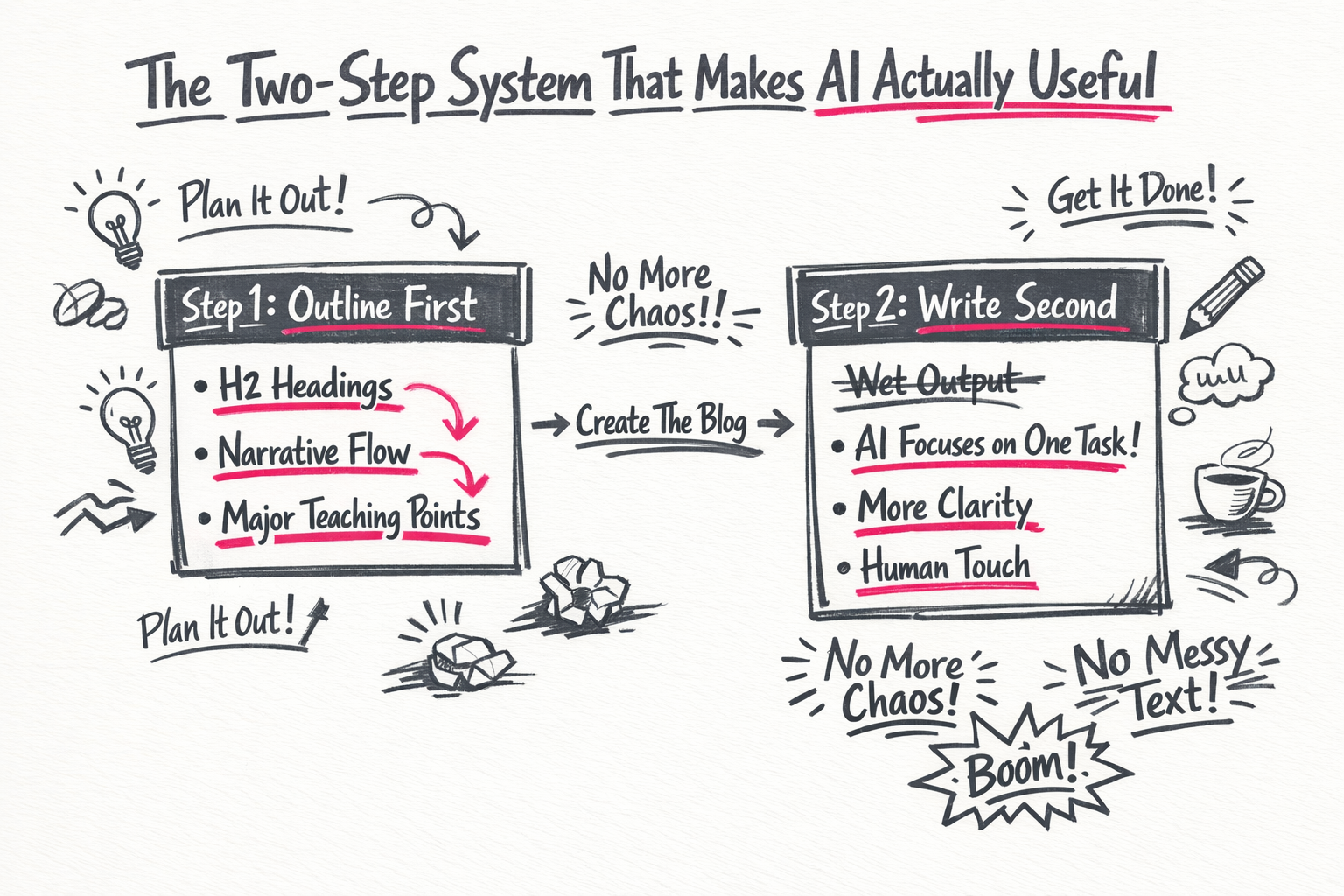
The fix is simple but not obvious. You need two steps, not one. Structure first, content second. This matters more than most people realise because it changes everything about how useful AI actually becomes.
Why Structure Comes Before Everything Else
When you jump straight from transcript to blog, you’re forcing AI to solve two problems at once: figuring out what your content means and how to organise it. It can’t do both well. It produces what I call “wet” output – technically accurate but lacking bones.
Structure is what transforms that. Before you write a single paragraph, you generate a blog outline: your H2 headings, your section hierarchy, your narrative flow. This isn’t about making a pretty table of contents. It’s about forcing linear thinking before prose happens.
Why does this matter for SEO? Because Google rewards clarity and architecture. A properly structured post with clean heading hierarchy, logical flow, and distinct sections performs better than rambling prose. But it also matters for storytelling. You’re taking readers through a journey where each section teaches something specific, builds on what came before, and makes sense as a whole.
How to Build an Outline That Actually Works
A proper outline isn’t a brain dump of ideas. It’s a series of H2 headings that represent each major teaching point or narrative turn in your video. Under each H2, you might jot one or two sentence descriptors of what that section covers. That’s it.
When you’re creating blog posts from videos, this outline becomes your structure for repurposing content. You’re not writing one giant piece; you’re writing five or six smaller, focused sections that connect to each other. Each one targets a specific search intent or answers a specific question your audience came with.
I use Claude to generate these outlines. It’s fast, it understands context, and the hierarchy it creates is clean. Then once the outline is locked in, I use ChatGPT section by section to write the actual prose. That two-step process means the AI is doing one thing at a time, and both steps benefit from my human direction.
Most people skip this because it feels like extra work. It’s not. It’s the difference between content that lands and content that dissolves. You’re not adding steps; you’re replacing one mediocre step with two focused ones. The outline saves time because the writing gets easier when the structure is already decided.
If you want to see this system mapped out with actual prompts you can adapt, I’ve built it into Turn One Video Into an SEO-Enhanced Blog Post. It walks you through extracting a transcript, building the outline with the right prompts, then writing each section with structure already in place. No ambiguity. No wet output.
The core principle is this: respect your content enough to structure it before you ask AI to polish it. Your video already has your voice, your expertise, your humanity. The outline protects those things. The writing just makes them readable.
Building Your Own System So You’re Not Dependent on New Ideas
Here’s the thing nobody tells you: you don’t need to be a blogging expert to turn video content into blog posts that drive traffic. I’m not. What I am is someone who knows how to build communities, run live events, and create content that people actually want to show up for. That’s my edge, and it’s become my content fuel.
I’ve spent the last few months building what I call a blog generation machine, and it’s changed how I think about leverage entirely. Instead of chasing new ideas constantly, I’m extracting maximum value from what I’m already doing. Every live event I host, every community conversation I facilitate, every video I record – that’s all raw material waiting to be repurposed.
The shift from single blog post to system is where the real multiplication happens. You move from “I need to write something this week” to “I have a structured way of converting my existing content into multiple formats.” That’s not just easier. It’s the difference between content feeling like a job and content feeling like a natural extension of what you’re already building.
Why Systemising Repurposing Multiplies Your Leverage
When you have a system in place, you’re not reinventing the wheel each time. You’re following a process that you’ve already tested and refined. The first time you convert video content into blog posts that drive traffic, it takes thought and experimentation. The tenth time? It’s muscle memory.
Systems also free you up mentally. I have a baby. I’m trying to build sustainable content production around a life that doesn’t revolve around content. A system means I can batch my work, delegate parts of it, and still maintain consistency without burning out. That’s not a nice-to-have. That’s essential.
The real leverage comes from your existing content sources. Live events you’re already hosting. Community conversations already happening. Videos you’re making anyway. Convert video transcripts to blog posts, and suddenly you’re not dependent on fresh ideas every single week. You’re dependent on showing up and doing the work you’d be doing anyway.
Identifying Your Content Sources
Before you build the system, get clear on where your content actually lives. What are you already doing that creates raw material? For me, it’s live events and community interaction. For you, it might be podcasts, client calls, workshop recordings, or community discussions.
Once you map out your sources, the next step is straightforward: capture them properly. Tools like Descript let you transcribe and edit video like text, turning your video content into structured, searchable material. Then you’ve got options. You can repurpose segments into shorts using Opus, extract key concepts for blog posts, turn Q&A into FAQs, or build threads from key moments.
The misconception that kills most people is thinking they need to be a blogging authority to do this well. You don’t. You need to be an authority on something that generates content naturally. You need a system to capture it. And you need to know your audience well enough to decide what angle will resonate.
I built my system on Make.com because I wanted something I could customise and automate without learning to code. Your setup might look different. The point isn’t the tool. The point is building something that actually fits your life and your workflow, so it sticks.

The SEO Fundamentals That Actually Matter (Without Becoming an SEO Expert)
Here’s what I want you to understand about SEO: it’s one part of the puzzle, not the whole thing. I see people obsess over ranking on Google as if it’s the only traffic source that matters. The reality? You could nail every technical SEO signal and still get crickets if nobody shares your work or finds it through your community.
That said, the basics do matter. Not because they’re magic. But because they make your content legible to both search engines and humans, and that’s worth doing right.
Structure Is How Search Engines Read Your Work
When you turn video content into blog posts, your structure does the heavy lifting. Don’t just bold a word and call it a heading. Use actual H2 and H3 tags. Search engines need to see a clear hierarchy to understand what your post is about and how it’s organised. It’s like the difference between a messy room and a tidy one – the tidy room tells a story about what belongs where.
This is where that two-step outline approach you’ve already learned becomes so valuable. A solid outline naturally creates the structure search engines want. You’re not retrofitting SEO onto your writing; you’re building it in from the start.
The Two Things That Actually Signal Value
Alt text on images matters more than people realise. Not because you’re keyword-stuffing (please don’t). But because it tells search engines what the image shows, and it makes your content accessible. If you’re using a screenshot or diagram to explain something, describe it naturally and include your keyword where it fits. That’s it.
Internal links and external links create what I call a web of trust. When you link out to other valuable resources, you’re not weakening your own authority – you’re showing Google you know your space. And when you link to your own previous posts? You’re creating pathways for readers and telling search engines these pieces belong together.
The real win here is this: a strategy that converts video transcripts to blog posts with thoughtful linking means you’ve got multiple entry points for readers. One person might land on your SEO post, find a link to your systems post, and suddenly they’re deeper in your work.
Traffic Comes From What You Build, Not Just What Ranks
You can have perfect technical SEO and still fail if nobody knows your post exists. I’m telling you this because I want you to stop waiting for Google to deliver your audience on a silver platter. It won’t happen that way, especially not quickly.
The posts that actually drive traffic are the ones you actively share with your community, the ones people screenshot and send to friends, the ones that solve a specific problem someone’s asking about in your audience right now. That’s how you leverage existing video content for SEO the right way – technical structure supports human connection, not the other way round.
Your job is to get the fundamentals right (clear structure, accessible images, sensible linking) and then do the work of bringing people to your posts yourself. Build your community. Share what you make. Let the SEO do what it’s supposed to do: make sure your work is findable when someone’s actively looking for it.
That’s not a limitation. That’s freedom.